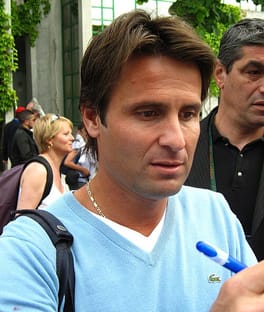
Photo: Charlie Cowins, Belmont, NC, USA / CC BY 2.0 (source: Wikimedia Commons)
Fabrice Santoro is a tennis player and tennis coach, born on December 9, 1972 in Tahiti, France. Fabrice Santoro is 53 years old as of 2026. The listed height is 178 cm.
My Take
Fabrice Santoro is one of those players I'll always respect more for craft than for trophies. Born on Tahiti in 1972, he built a famously long career out of guile rather than power, hitting two-handed off both wings, a style that made him the kind of opponent nobody enjoyed drawing. I love that crowds and fellow pros both warmed to him; that double approval is rare. What strikes me most is how much of his best work came late, which tells me he kept reinventing himself. He's proof that tennis can reward a thinker as much as an athlete.
This take was written by generative AI, one per person, from publicly reported facts (editorial policy). It is a reading of the record, not reporting.
1. Profile
- Name (English)
- Fabrice Santoro
- Name (Japanese)
- ファブリス・サントロ
- Reading
- ふぁぶりす・さんとろ
- Born
- December 9, 1972 (age 53)
- Origin
- Tahiti, France
- Height
- 178 cm
- Occupation
- tennis player / tennis coach
- Zodiac / Chinese zodiac
- Sagittarius / Rat
2. Links
3. About this entry
Tags
- Last updated
Facts are limited to publicly available information up to 2024; non-public or unconfirmed items are omitted. English text is machine-assisted (facts translated by Sonnet, "My Take" written by Opus 4.8). The Japanese page is the source of record.
Frequently asked questions
When was Fabrice Santoro born?
Born December 9, 1972 (age 53).
Where is Fabrice Santoro from?
Fabrice Santoro is from Tahiti, France.
What does Fabrice Santoro do?
Fabrice Santoro works as tennis player, tennis coach.
How tall is Fabrice Santoro?
Fabrice Santoro is 178 cm.
Tennis player — see all → · Tennis coach — see all → · More people from France →