Steel Beneath the Grace: How Mao Asada Bet Her Life on the Triple Axel
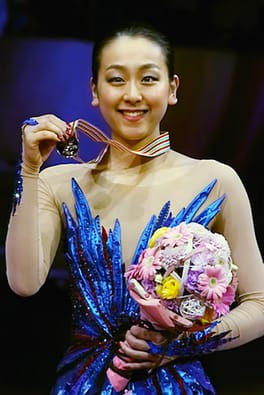
A soft smile, delicate movements, the lingering innocence of a girl. And then she steps onto the ice and begins her approach, and everything changes. Three and a half rotations in the air — the triple axel. Across the entire world of women's figure skating, only a handful of skaters have ever landed it. Mao Asada chose this most difficult of jumps as her own weapon and used it to challenge the very summit of her sport.
Born on September 25, 1990, in Meito Ward, Nagoya, she laced up her skates at five, swept the senior world at fifteen, and would go on to win the World Championships three times. Yet what lodged most deeply in people's memories was something beyond any record: the sight of a skater who, win or lose, believed in her own program right down to the final note.
This is the story of a skater whose gentle appearance concealed a will of steel — who fell, who wept, who rose again, and who skated her own narrative onto the ice.
A Girl from Nagoya Finds the Ice
Mao Asada began skating at the age of five. An ordinary girl attending Takabari Elementary School in Nagoya, she revealed on the rink a talent that quickly caught the eyes of her coaches. Under Machiko Yamada, who guided her early years, she honed her fundamentals and walked the competitive path alongside her older sister, Mai.
She distinguished herself in international competition from her junior days, and while still in her early teens she was already attempting the triple axel — a jump so difficult that even many male skaters shy away from it. Behind that endearing exterior lay a refusal to flee from the hardest challenges, a trait that would come to define her entire career.
A Stunning Senior Debut at Fifteen
In 2005, Mao Asada stepped onto the senior stage. At that year's Grand Prix Final she defeated reigning world champion Irina Slutskaya and won outright — a fifteen-year-old besting the very best in the world.
That electrifying debut announced the arrival of a new star in Japanese figure skating. The following year she captured her first national title, the first of six Japanese championships she would eventually claim. In 2008 she won the World Championships for the first time, finally ascending to the throne as world champion in every sense.
Silver in Vancouver, Three Times World Champion
At the 2010 Vancouver Winter Olympics, Mao Asada became the first woman in history to land three triple axels at a single Games, taking the silver medal. Gold eluded her, but her insistence on attempting the hardest jumps drew applause from around the world. That same year she won her second World Championship, sharing the spotlight with men's champion Daisuke Takahashi.
Then, in 2014, she won the World Championships for a third time — the first Japanese woman ever to do so. Her short program set a world-record score, recognized by Guinness World Records. Even when coaches gently urged her not to push so hard, she chose, every time, the most difficult program with which to compete.
The Tears of Sochi and a Miraculous Free Skate
No account of Mao Asada can omit the 2014 Sochi Olympics. In the short program she suffered an unexpected breakdown, tumbling far down the standings. Across the country, fans wept in front of their televisions.
But the next day came the free skate. She delivered what may have been the finest performance of her entire career, attacking every jump and skating it through to the end. The arena and viewers at home alike were moved to tears. Her sixth-place finish mattered far less than the performance itself, which is etched forever in countless hearts. "I was able to skate all the way to the end," she said afterward — a statement of beauty that transcended any result.
Retirement and a Life Spreading the Joy of Skating
On April 10, 2017, Mao Asada announced her retirement from competition. But her story with skating did not end there. In 2018 she launched the Mao Asada Thanks Tour, producing and starring in a show that traveled across Japan. In 2022 she produced the ice show BEYOND, continuing to enchant younger skaters and audiences alike.
In 2021 she published a book, My Love for Skating. As the title suggests, she loves the sport from the bottom of her heart and seeks to pass that joy on to the next generation. Her hobbies include jigsaw puzzles, LEGO, and cooking, and she shares her life — now free of competitive pressure — with her toy poodle, Aero.
Gentle and delicate on the outside, a block of pure steel within — Mao Asada's appeal lay precisely in that seeming contradiction. She never fled the triple axel, rose every time she fell, and held fast to believing in her own program rather than to winning or losing.
The image of her failing in Sochi, weeping, and then delivering the performance of her life the next day became, for many, a touchstone for what beauty truly means. Even after retirement she remains on the ice, radiating an inexhaustible love for skating. Beyond the color of any medal, Mao Asada is a skater who leaves a story in the human heart.