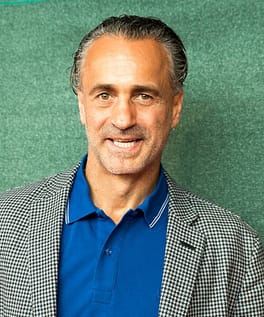
Photo: Frank Schwichtenberg / CC BY-SA 3.0 (source: Wikimedia Commons)
Maurizio Gaudino is an association football player and association football coach, born on December 12, 1966 in Brühl, Karlsruhe Government Region, Germany. That puts Maurizio Gaudino at 59 years old in 2026. The listed height is 183 cm.
My Take
Gaudino interests me as a player who carried two cultures onto the pitch. An Italian name, a German birthplace in Brühl, and a career that spanned Stuttgart, Eintracht Frankfurt, Bochum and a Premier League stint at Manchester City. That dual identity must have shaped how he saw the game, and at 183 cm he had the frame to dictate from midfield. What I admire most is his refusal to drift away from football. Now serving as a director of football at Reutlingen, he stays embedded in the sport's machinery. I have a soft spot for lifers like him who never quite leave the game behind.
This take was written by generative AI, one per person, from publicly reported facts (editorial policy). It is a reading of the record, not reporting.
1. Profile
- Name (English)
- Maurizio Gaudino
- Name (Japanese)
- マウリッィオ・ガウディーノ
- Reading
- まうりっぃお・がうでぃーの
- Born
- December 12, 1966 (age 59)
- Origin
- Brühl, Karlsruhe Government Region, Germany
- Height
- 183 cm
- Occupation
- association football player / association football coach
- Zodiac / Chinese zodiac
- Sagittarius / Horse
2. Links
3. About this entry
Tags
- Last updated
Facts are limited to publicly available information up to 2024; non-public or unconfirmed items are omitted. English text is machine-assisted (facts translated by Sonnet, "My Take" written by Opus 4.8). The Japanese page is the source of record.
Frequently asked questions
When was Maurizio Gaudino born?
Born December 12, 1966 (age 59).
Where is Maurizio Gaudino from?
Maurizio Gaudino is from Brühl, Karlsruhe Government Region, Germany.
What does Maurizio Gaudino do?
Maurizio Gaudino works as association football player, association football coach.
How tall is Maurizio Gaudino?
Maurizio Gaudino is 183 cm.
Association football player — see all → · Association football coach — see all → · More people from Germany →