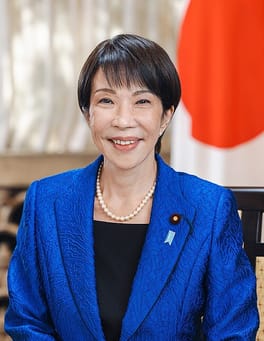
Photo: Immediate source: MOFA/Japanese Embassy to South Africa, probable source: Cabinet Public Affairs Office / CC BY 4.0 (source: Wikimedia Commons)
Sanae Takaichi is a news presenter, politician and writer, born on March 7, 1961 in Nara Prefecture, Japan. As of 2026, Sanae Takaichi is 65 years old. Education on record includes Nara Prefectural Unebi High School and Faculty of Business Administration, Kobe University. Credited works include 1989年, 1991年3月29日 and 1992年.
My Take
Whatever one thinks of her politics, I find Sanae Takaichi's trajectory genuinely remarkable. She came from Nara, studied business at Kobe University, worked as a television presenter and writer, and then spent decades grinding through Japan's notoriously male-dominated political world before becoming the country's first female prime minister in October 2025. That kind of persistence — losing, regrouping, trying again — is rarer than talent. I suspect her broadcasting years taught her how to take a punch in public and keep her composure, a skill most politicians never master. Agree or disagree with her, she has already secured a line in the history textbooks, and I find watching that happen in real time fascinating.
This take was written by generative AI, one per person, from publicly reported facts (editorial policy). It is a reading of the record, not reporting.
1. Profile
- Name (English)
- Sanae Takaichi
- Name (Japanese)
- 高市早苗
- Reading
- たかいち さなえ
- Born
- March 7, 1961 (age 65)
- Origin
- Nara Prefecture, Japan
- Occupation
- news presenter / politician / writer / analyst / television presenter
- Zodiac / Chinese zodiac
- Pisces / Ox
2. Background
- High school
- Nara Prefectural Unebi High School
- University
- Faculty of Business Administration, Kobe University
3. Relationships
- Spouse
- 山本拓
4. Works & records
Works summary
- Appearances
- 5
Filmography / notable works
| Category | Title | Role |
|---|---|---|
| Appearance | 1989年 | こだわりTV PRE☆STAGE(テレビ朝日系列) |
| Appearance | 1991年3月29日 | 朝だ!どうなる(フジテレビ系列) |
| Appearance | 1992年 | アプラスフィナンシャル(旧・大信販) |
| Appearance | 2021年7月10日・7月24日・12月11日・12月25日 | 東京ホンマもん教室(東京MX) |
| Appearance | 2021年9月2日 | ひるおび!(TBSテレビ系列) |
5. Links
- Official sitehttps://sanae.gr.jp
- Instagramhttps://www.instagram.com/takaichi_sanae/
- Xhttps://x.com/takaichi_sanae
- Wikipedia (English)https://en.wikipedia.org/wiki/Sanae%20Takaichi
- Wikipedia (Japanese)https://ja.wikipedia.org/wiki/%E9%AB%98%E5%B8%82%E6%97%A9%E8%8B%97
- Wikidatahttps://www.wikidata.org/wiki/Q1705028
6. About this entry
Tags
- Last updated
Facts are limited to publicly available information up to 2024; non-public or unconfirmed items are omitted. Works and profile fields sourced from Wikipedia reflect content as of 2026-08-26. English text is machine-assisted (facts translated by Sonnet, "My Take" written by Opus 4.8). The Japanese page is the source of record.
Frequently asked questions
When was Sanae Takaichi born?
Born March 7, 1961 (age 65).
Where is Sanae Takaichi from?
Sanae Takaichi is from Nara Prefecture, Japan.
What does Sanae Takaichi do?
Sanae Takaichi works as news presenter, politician, writer, analyst, television presenter.
What is Sanae Takaichi known for?
Notable works include 1989年, 1991年3月29日, 1992年.
News presenter — see all → · Politician — see all → · More people from Japan →