The Man Who Could Silence a Room by Standing Still: Toshiro Mifune
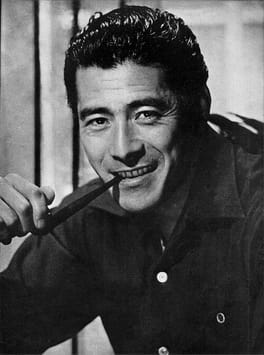
What does it mean for an actor to be great? Delivering lines beautifully, crafting subtle expressions, these are real skills. But anyone who has watched Toshiro Mifune remembers something more primal. A man simply stands, glares at you, scratches the back of his neck, and suddenly the entire frame crackles with electricity. Before a single word is spoken, the audience's instincts have already reacted.
This is the story of a man born in Qingdao, China, swept up by war, and tossed almost by accident into the world of cinema. He met a director named Akira Kurosawa, struck fear into film lovers around the globe, and came to be known as "Mifune of the World." It is a story less about acting technique than about sheer presence.
Born on the Continent, Swallowed by War
Toshiro Mifune was born on April 1, 1920, in Qingdao, Shandong Province, China. In 1925 his family moved to Dalian, where he attended Dalian Middle School. He did not go on to university.
In 1940 he was conscripted into the Imperial Army and assigned to the photography unit of the 7th Army Aviation Training Corps in Manchuria. He had no ambition to become an actor. His youth belonged not to cinema but to the air of the Asian mainland and the hard reality of military life. The distinctive wildness and tension he would later radiate on screen were surely not unconnected to these origins. Before he was a star, he was simply a young man of the wartime generation.
A Door That Opened by Chance
His turning point came after the war. In 1946 he passed Toho's first-generation New Face audition. It happened almost by accident, less a man chasing an acting career than a door choosing him.
The following year, in 1947, he made his film debut in The Culmination of Snow. That set was the site of a fateful meeting that would rewrite film history: his first collaboration with Akira Kurosawa. In this rough, supposedly ill-mannered young man, Kurosawa saw something no one else possessed. Not a polished, well-trained student of acting, but the kind of person who dominates the world the instant he appears on screen. That was Mifune.
The Golden Age with Kurosawa, and the World Takes Notice
Rashomon (1950) won the Golden Lion at the Venice International Film Festival the following year, instantly placing Japanese cinema on the world map. With Seven Samurai (1954), Mifune's fame became undeniable.
Throne of Blood, The Hidden Fortress, Yojimbo, Sanjuro, Red Beard: the films he made with Kurosawa became monuments that filmmakers worldwide still study. For Yojimbo and Red Beard he won Best Actor at the Venice International Film Festival twice, and he swept Japan's Blue Ribbon and Kinema Junpo awards as well. The ronin and samurai he played went on to influence the very image of the Hollywood Western and action hero. One of the original templates of "cool" was forged right here.
Behind the Glare, a Man Who Could Cook
In 1962 Mifune founded Mifune Productions, stepping beyond acting to make films himself. His work crossed borders too; in 1976 he played Admiral Isoroku Yamamoto in the Hollywood epic Midway.
Yet in stark contrast to his ferocious screen presence, Mifune was known for his cooking. In the army he ran the mess and cooked for his comrades, and in 1975 he opened a Japanese restaurant in Munich. A man who radiated such animal intensity on screen worked with delicate, careful hands. That very gap is what makes him more than a "strong actor," it makes him a deeply human one.
A Man of Principle Before He Was a Star
One story captures his character: he drove himself to the studio without an entourage and greeted everyone, even the extras, without a trace of airs. Even after his name rang out across the world, he stayed humble and put basic decency first.
He received Japan's Medal with Purple Ribbon in 1986, France's Ordre des Arts et des Lettres in 1989, and the Order of the Sacred Treasure, 3rd Class, in 1993. Honors at home and abroad attest to his journey. But when we speak of Mifune, what comes to mind before any award is those eyes, a piercing gaze that tells your instincts not to provoke him. It was less something he manufactured through acting than something that simply seeped out of who he was.
On December 24, 1997, Toshiro Mifune died of multiple organ failure at a hospital in Mitaka, Tokyo, at the age of 77, two years after losing his wife, Sachiko Yoshimine.
On screen, he still stands there, unchanged. In a single wordless moment he commands the air and silences the viewer. We have rarely seen another actor so fully embody that word beyond technique: presence. "Mifune of the World" was never an exaggeration.