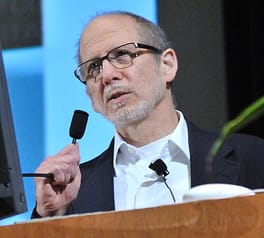
Photo: Raymond MacDougall / Public domain (source: Wikimedia Commons)
Bert Vogelstein is an oncologist, university teacher and scientist, born on June 2, 1949 in Baltimore, Maryland, United States. Bert Vogelstein is 77 years old as of 2026. Education on record includes Pikesville High School and University of Pennsylvania. Recorded honors include Breakthrough Prize in Life Sciences (2013), Princess of Asturias Award for Technical and Scientific Research (2004), Harvey Prize (2001) and 5 more.
My Take
Vogelstein's award list reads like a greatest-hits of biomedical science: Gairdner, Breakthrough, Asturias, Horwitz. What strikes me is how invisible this kind of greatness is to the public. He spent decades at Johns Hopkins decoding the genetics of colorectal cancer, and if any of us ever benefit from earlier detection or smarter treatment, his fingerprints may quietly be on the science underneath. I find that profoundly moving. The patient, unglamorous grind of the lab rarely earns celebrity, yet it shapes lives at scale. He is exactly the sort of person a database of notable people should make a point of remembering.
This take was written by generative AI, one per person, from publicly reported facts (editorial policy). It is a reading of the record, not reporting.
1. Profile
- Name (English)
- Bert Vogelstein
- Name (Japanese)
- バート・フォーゲルシュタイン
- Reading
- ばーと・ふぉーげるしゅたいん
- Born
- June 2, 1949 (age 77)
- Origin
- Baltimore, Maryland, United States
- Occupation
- oncologist / university teacher / scientist / pathologist
- Zodiac / Chinese zodiac
- Gemini / Ox
2. Background
- High school
- Pikesville High School
- University
- University of Pennsylvania
Awards & achievements
- 2013 Breakthrough Prize in Life Sciences
- 2004 Princess of Asturias Award for Technical and Scientific Research
- 2001 Harvey Prize
- 1992 Canada Gairdner International Award
- 1994 Ernst Schering Prize
- 1998 Paul Ehrlich and Ludwig Darmstaedter Prize
- 1994 Howard Taylor Ricketts Prize
- 1998 Louisa Gross Horwitz Prize
3. Links
- Official sitehttps://www.hhmi.org/research/investigators/vogelstein_bio.html
- Wikipedia (English)https://en.wikipedia.org/wiki/Bert%20Vogelstein
- Wikipedia (Japanese)https://ja.wikipedia.org/wiki/%E3%83%90%E3%83%BC%E3%83%88%E3%83%BB%E3%83%95%E3%82%A9%E3%83%BC%E3%82%B2%E3%83%AB%E3%82%B7%E3%83%A5%E3%82%BF%E3%82%A4%E3%83%B3
- Wikidatahttps://www.wikidata.org/wiki/Q827502
4. About this entry
Tags
- Last updated
Facts are limited to publicly available information up to 2024; non-public or unconfirmed items are omitted. English text is machine-assisted (facts translated by Sonnet, "My Take" written by Opus 4.8). The Japanese page is the source of record.
Frequently asked questions
When was Bert Vogelstein born?
Born June 2, 1949 (age 77).
Where is Bert Vogelstein from?
Bert Vogelstein is from Baltimore, Maryland, United States.
What does Bert Vogelstein do?
Bert Vogelstein works as oncologist, university teacher, scientist, pathologist.
University teacher — see all → · More people from the United States →