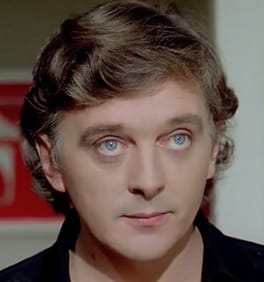
Photo: Dario Argento (director), Luigi Kuveiller (cinematographer), Seda Spettacoli (production) / Public domain (source: Wikimedia Commons)
David Hemmings was credited as an actor, film director and film producer. David Hemmings was born in Guildford, United Kingdom on November 18, 1941. Death is recorded on December 3, 2003, at the age of 62.
My Take
David Hemmings is one of those actors who defines an entire cultural moment rather than just a filmography. His turn as the restless fashion photographer in Antonioni's Blow-Up (1966) is so perfectly of its time — all cool arrogance, sexual ambiguity, and mod London swagger — that it's hard to imagine anyone else pulling it off. What I find genuinely impressive is how he refused to be a one-trick sixties relic: he kept working steadily through the decades, popping up in Gladiator and Gangs of New York late in his career with the kind of weathered gravitas that comes from a lifetime on set. The fact that he also directed, produced, wrote, and even sang makes him feel like someone who was simply too restless to stop at one craft. Gone at 62 in 2003, and it still feels a little too soon.
This take was written by generative AI, one per person, from publicly reported facts (editorial policy). It is a reading of the record, not reporting.
1. Profile
- Name (English)
- David Hemmings
- Name (Japanese)
- デヴィッド・ヘミングス
- Reading
- でゔぃっど・へみんぐす
- Born
- November 18, 1941 – December 3, 2003
- Origin
- Guildford, United Kingdom
- Occupation
- actor / film director / film producer / screenwriter / singer-songwriter
- Zodiac / Chinese zodiac
- Scorpio / Snake
2. Links
3. About this entry
Tags
- Last updated
Only publicly available facts are listed; non-public or unconfirmed items are omitted. Base data was compiled from Wikidata from June 2026 onward; ages are recalculated daily and deaths are checked against Wikidata on an ongoing basis. English text is machine-assisted (facts translated by Sonnet, "My Take" written by Opus 4.8). The Japanese page is the source of record.
Frequently asked questions
When was David Hemmings born?
David Hemmings was born on November 18, 1941.
When did David Hemmings die?
David Hemmings died on December 3, 2003, aged 62.
Where was David Hemmings from?
David Hemmings was from Guildford, United Kingdom.
What did David Hemmings do?
David Hemmings worked as actor, film director, film producer, screenwriter, singer-songwriter.
Actor — see all → · Film director — see all → · More people from the United Kingdom → · More people born on November 18 →