The Master Who Can't Put Down the Pencil: Hayao Miyazaki, Who Retires and Always Returns
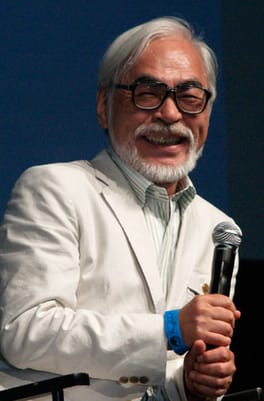
White hair, round glasses, and an apron. That single image alone is enough to bring one man to mind for people all over the world. Hayao Miyazaki, the director who, through the films of Studio Ghibli, lifted Japanese animation into a globally recognized art form.
Born in Tokyo on January 5, 1941, he has spent more than half a century pouring his obsession into drawing by hand. Things that fly, abundant nature, and children who look at the world straight-on. His decades of relentlessly digging into the same themes are, in a sense, the life story of a single artist, stubborn to the point of being touching.
It Began With a Single Drawing
Miyazaki's career began not with glamorous directing, but with the patient work of an animator. After graduating from the Faculty of Political Science and Economics at Gakushuin University, he joined Toei Animation, now Toei Animation Co., in 1963.
A young man who had been moved by animated films as a student and set out to make them, he sharpened the craft of breathing life into each individual drawing. Later, through stints at studios such as A Pro and Nippon Animation, his style gradually took firm shape.
Founding Ghibli and a Golden Age
In 1979 he released his first feature as director, The Castle of Cagliostro, and in 1984 came Nausicaa of the Valley of the Wind. The following year, in 1985, he co-founded Studio Ghibli together with his close ally Isao Takahata and others.
From here, Miyazaki's golden age began. My Neighbor Totoro, Kiki's Delivery Service, Princess Mononoke. Alongside longtime collaborators such as producer Toshio Suzuki and composer Joe Hisaishi, he sent one defining film after another out into the world.
Spirited Away, Embraced by the World
Released in 2001, Spirited Away became a landmark in Japanese box-office history.
The film also transformed how the world saw his work. In 2002 it won the Golden Bear at the Berlin International Film Festival, and the following year it took the Academy Award for Best Animated Feature. It was the moment Japanese animation was formally recognized at the very top of world cinema. In 2005 he was also honored with a Golden Lion for Lifetime Achievement at the Venice International Film Festival.
The Man Who Retires and Takes It Back
No portrait of Miyazaki is complete without his repeated retirement announcements. When he declared in 2013, after the release of The Wind Rises, that he was stepping away from feature filmmaking, many took him at his word.
Yet before long he rescinded that retirement, releasing The Boy and the Heron in 2023. The film went on to win both the Golden Globe and the Academy Award for Best Animated Feature in 2024. It was one more proof of an artist who simply cannot stop creating.
Holding to Handwork in an Age of Efficiency
Miyazaki's stories never wrap themselves up in a tidy bow of good versus evil. That very depth, the kind that leaves you questioning long after the credits, is why his films continue to be loved for so long.
His deep interest in aircraft and his affection for nature breathe through every corner of his work. In an age that prizes the fast and convenient, his stubborn insistence on the laborious, hand-drawn method speaks to the heart of who he is as an artist. He was named a Person of Cultural Merit in 2012 and received the Academy Honorary Award in 2014, his achievements honored in full.
His contribution in carrying Japanese animation to the world is so vast that no amount of gratitude could ever be enough. And above all, it is the humanity of a man who says he will quit yet cannot release his passion for creating that moves us just as much as his films do.
You can trace Hayao Miyazaki's complete filmography and the arc of his many honors in detail on his celeb-db profile.