Bringing the World to Tears with a Silent Dinner Table: Hirokazu Kore-eda's Quiet, Endless Question of "What Is Family?"
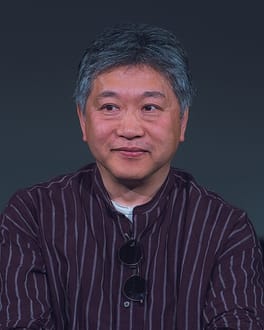
No dramatic incidents. No loud declarations. And yet, with nothing more than a quiet scene at a dinner table, he can gently break open the viewer's tears. Such is the cinema of Hirokazu Kore-eda.
Armed with an observational eye honed on documentary sets, he has gazed steadily at a single question: Is family a matter of blood, or of the time we spend together? That quiet inquiry would eventually carry him to the very summit of the Cannes Film Festival.
This is the story of how a literary youth from Nerima, Tokyo, became a world-renowned storyteller of family.
A Literary Youth from Nerima and the World of Television
Hirokazu Kore-eda was born on June 6, 1962, in Nerima, Tokyo. After attending local elementary and junior high schools and Tokyo Metropolitan Musashi High School, he went on to study literary arts at Waseda University's First School of Letters. In his school years he even served as captain of the volleyball team—days spent engaging with people as much as with literature.
Upon graduating in 1987, he joined the production company TV Man Union. Rather than starting in film, he first immersed himself in television documentary work, and this experience became the foundation of his later style. Not staging events, but quietly watching people's natural expressions and the passage of time—that posture was forged here.
"Maborosi" — Straight to Venice
In 1995, Kore-eda finally made his debut as a feature film director. His first work, "Maborosi," won the Golden Osella for Cinematography at the 52nd Venice International Film Festival. For the world's festivals to recognize his imagery on a debut alone was a brilliant launch.
Openly influenced by Italian Neorealism—especially "Bicycle Thieves" and "Rome, Open City"—his gaze was, from the very start, fixed on the lives of ordinary people and the time flowing through them.
Children and the Magic of Natural Performance
"Nobody Knows" (2004) was the film that cemented Kore-eda's international name. Its young star, Yuya Yagira, won Best Actor at the 57th Cannes Film Festival as the youngest recipient in its history, astonishing the world.
The true heart of Kore-eda's direction lies in his ability to draw natural expressions from his actors, especially children. By not letting them "act too much," he captures genuine, unmanufactured moments on screen—a method that can only be called magic. With "Still Walking" (2008), "Like Father, Like Son" (2013, Jury Prize at the 66th Cannes), and "Our Little Sister" (2015), he continued to portray the subtle textures of family life.
"Shoplifters" and the Summit of Cannes
In 2014, Kore-eda left TV Man Union, his longtime home, and founded the creative collective "Bunbuku." Then, in 2018, his career reached its peak. "Shoplifters" won the Palme d'Or, the highest honor at the 71st Cannes Film Festival—the first Japanese director to do so in 21 years, and only the fourth in history.
Through a makeshift family of people bound not by blood but by closeness, he posed to the world a tender yet piercing question: family cannot be chosen, but a family can be made. The following year, the film also won Best Picture and Best Director at the 42nd Japan Academy Film Prize.
Crossing Borders, the Question Continues
Kore-eda's inquiry does not stop at Japan's borders. In 2019 he directed "The Truth" in France with Catherine Deneuve and others, and in 2022 he filmed "Broker" set in South Korea, continuing to confront the universal theme of family across languages and cultures.
Then, in 2023, "Monster" won the Best Screenplay Award and the Queer Palm at the 76th Cannes Film Festival. Through the eyes of young boys, the film quietly confronted the dangers of assumption and prejudice—proof that his questions keep deepening. Even as he reveals a playful side, collecting Frankenstein figurines, he calmly and steadily refuses to stop moving forward.
Without relying on flashy devices, simply by continuing to watch human lives and faces, Hirokazu Kore-eda opened the door for the world to recognize the delicacy of Japanese cinema.
After watching his films, you find yourself wanting to be just a little kinder to your own family. Perhaps it is the time spent together, more than blood, that makes a family. That quiet question will surely linger in our hearts for a long time to come.