From a Backstreet Workshop to Global Enterprises: Kazuo Inamori's 90 Years of Altruism
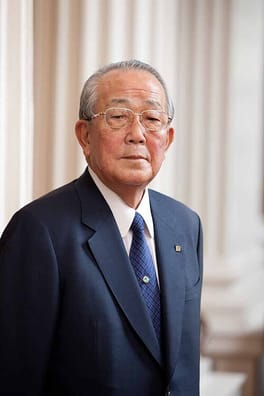
In 1959, a tiny company drew its first breath in a corner of Kyoto. No one imagined that this little workshop would one day grow into Kyocera, a name known around the world. Its founder was Kazuo Inamori, an engineer who had come up from Kagoshima with little but his skill and his conviction.
His life was no ordinary success story. He built Kyocera, gave birth to KDDI, and resurrected a bankrupt Japan Airlines. Yet for all his rare achievements as a businessman, what Inamori preached throughout his life was not how to make money, but how to live. An altruistic mind, reverence for heaven and love for people, and the resolve to live each day with utmost sincerity. A businessman who became a Buddhist monk, his path remains a compass for managers to this day.
A Kagoshima Boy Meets Technology
Kazuo Inamori was born on January 21, 1932, in Kagoshima City. He attended Nishida Elementary School and Kagoshima Gyokuryu High School before studying applied chemistry at the Faculty of Engineering of Kagoshima Prefectural University (later merged into Kagoshima University). It was hardly a gilded elite path. After graduating in 1955, he joined Shofu Industries in Kyoto.
The company he joined was in a terrible state, mired in labor disputes. But the young Inamori did not grow bitter; instead he threw himself into research on fine ceramics. The results he accumulated in those Shofu years would later open the door to founding his own company. Those days spent confronting technology amid adversity became the wellspring of his management philosophy.
Kyocera, Begun with Eight Colleagues
In 1959, Inamori and eight colleagues from Shofu founded Kyoto Ceramic Co., Ltd. (now Kyocera); he became its president in 1966. But his technical skill and passion quickly bore fruit. He earned the first Small and Medium Enterprise Research Center Award in 1968, the Okochi Memorial Production Prize in 1972, and an Agency for Science and Technology Director-General Award in 1974 — recognition on both the technical and managerial fronts.
Underpinning Kyocera's rise was a management method Inamori devised himself: "Amoeba Management." By dividing the organization into small profit-and-loss units so that every employee thought like a manager, the system became a model that countless companies would later study. His famous formula — that results in work and life equal mindset times effort times ability — was honed in this era.
Taking On Telecom, Giving the World a Prize
In 1984, Inamori made a bold new gamble. He established the venture that would become KDDI, seeking to break open the era's telecommunications monopoly. That challenge came to fruition in 2000 with the formation of KDDI through the merger of DDI, KDD, and IDO.
That same year, 1984, he planted another great seed. He poured his personal fortune into founding the Inamori Foundation and creating the international Kyoto Prize. Honoring those who have contributed to humanity in science, technology, thought, and the arts, the prize is now a globally recognized authority. Returning to society what he had gained through business — here, too, his altruistic mind took concrete form.
A Businessman Becomes a Monk
In 1997, Inamori chose a startling path. He was ordained at Enpuku-ji, a temple of the Rinzai Zen sect, entering the Buddhist priesthood. For a frontline business leader to become a monk astonished the public. Yet it was no mere gesture for effect. For a man who genuinely tried to live "for the world, for others," it was perhaps the most natural choice.
Then, in 2010, at the age of 78, Inamori took on the final great task of his life. He became chairman of the bankrupt Japan Airlines and led its reconstruction. Taking on the job without pay, he revived the airline through a transformation of mindset, and it was re-listed on the Tokyo Stock Exchange in November 2012. The dramatic turnaround that many had deemed impossible proved that his philosophy was no mere theory on paper.
The Legacy of Altruism
Inamori was not only a manager but also a remarkable author. Books such as "A Compass to Fulfillment," "Amoeba Management," and "Kyocera Philosophy" have been read far beyond the world of business. What he wrote about was never technical theory or moneymaking, but the fundamental question of how to live as a human being.
In 2019 he was named an Honorary Citizen of Kagoshima Prefecture, deeply revered by his hometown. His wife, Asako, is the fourth daughter of Woo Jang-choon. He kept preaching to the end the value of an altruistic mind and living each day in earnest.
On August 24, 2022, Kazuo Inamori quietly passed away at his home in Kyoto at the age of 90. It was a life that began in the corner of a small workshop, raised two world-class companies, and revived one that had gone bankrupt.
Despite achievements of such scale, what he kept speaking of to the very end was not his own accomplishments but the importance of living for others. A leader who taught how to live more fiercely than how to profit, sincere almost to the point of awkwardness. The words Inamori left behind — the altruistic mind — will go on giving people a push for years to come.