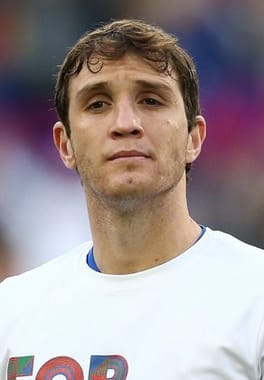
Photo: Антон Зайцев / CC BY-SA 3.0 (source: Wikimedia Commons)
Mário Fernandes is listed as an association football player. Mário Fernandes was born on September 19, 1990 in São Caetano do Sul, São Paulo, Brazil. The age as of 2026 is 36. Awards on record include Honoured Master of Sports of Russia (2018). The listed height is 186 cm.
My Take
Mário Fernandes has one of the more fascinating backstories in modern football. A Brazilian right-back born near São Paulo in 1990, he ended up naturalizing as Russian and playing for both national teams, which is rare and a little poignant given how those two football cultures differ. I remember him most for the 2018 World Cup run with Russia, and the 2018 Honoured Master of Sports award reflects how much that meant to his adopted country. At 186 cm he had the frame for an attacking full-back. To me he's a reminder that football identity can be genuinely transnational, shaped as much by where you're embraced as where you're born.
This take was written by generative AI, one per person, from publicly reported facts (editorial policy). It is a reading of the record, not reporting.
1. Profile
- Name (English)
- Mário Fernandes
- Name (Japanese)
- マリオ・フィゲイラ・フェルナンデス
- Reading
- まりお・ふぃげいら・ふぇるなんです
- Born
- September 19, 1990 (age 36)
- Origin
- São Caetano do Sul, São Paulo, Brazil
- Height
- 186 cm
- Occupation
- association football player
- Zodiac / Chinese zodiac
- Virgo / Horse
2. Background
Awards & achievements
- 2018 Honoured Master of Sports of Russia
3. Links
- Instagramhttps://www.instagram.com/mario.fernandes02/
- Wikipedia (English)https://en.wikipedia.org/wiki/M%C3%A1rio%20Fernandes
- Wikipedia (Japanese)https://ja.wikipedia.org/wiki/%E3%83%9E%E3%83%AA%E3%82%AA%E3%83%BB%E3%83%95%E3%82%A3%E3%82%B2%E3%82%A4%E3%83%A9%E3%83%BB%E3%83%95%E3%82%A7%E3%83%AB%E3%83%8A%E3%83%B3%E3%83%87%E3%82%B9
- Wikidatahttps://www.wikidata.org/wiki/Q2444565
4. About this entry
Tags
- Last updated
Facts are limited to publicly available information up to 2024; non-public or unconfirmed items are omitted. English text is machine-assisted (facts translated by Sonnet, "My Take" written by Opus 4.8). The Japanese page is the source of record.
Frequently asked questions
When was Mário Fernandes born?
Born September 19, 1990 (age 36).
Where is Mário Fernandes from?
Mário Fernandes is from São Caetano do Sul, São Paulo, Brazil.
What does Mário Fernandes do?
Mário Fernandes works as association football player.
How tall is Mário Fernandes?
Mário Fernandes is 186 cm.
Association football player — see all → · More people from Brazil →