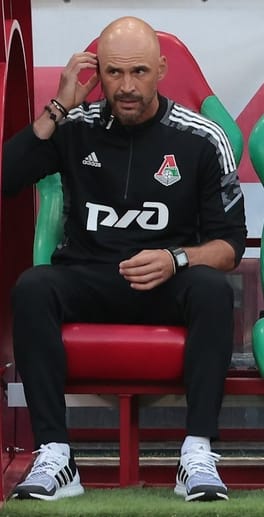
Photo: Антон Зайцев / CC BY-SA 3.0 (source: Wikimedia Commons)
Oleg Pashinin, born on September 12, 1974 in Degtyanka, Tambov Oblast, Russia, is an association football player and association football coach. As of 2026, Oleg Pashinin is 52 years old. The listed height is 182 cm.
My Take
Oleg Pashinin embodies a kind of loyalty that modern football rarely rewards. Fifteen seasons as a defender for Lokomotiv Moscow is an extraordinary commitment to one club, and staying on afterward as a coach and game analyst shows a man who genuinely loves the institution, not just the spotlight. Defenders like him do the unglamorous work, snuffing out attacks rather than scoring the goals that make headlines. I have a soft spot for these understated anchors, the players whose value only becomes obvious when you study the game closely. That he now applies that same analytical eye from the touchline feels like a fitting second act.
This take was written by generative AI, one per person, from publicly reported facts (editorial policy). It is a reading of the record, not reporting.
1. Profile
- Name (English)
- Oleg Pashinin
- Name (Japanese)
- オレグ・パシニン
- Reading
- おれぐ・ぱしにん
- Born
- September 12, 1974 (age 52)
- Origin
- Degtyanka, Tambov Oblast, Russia
- Height
- 182 cm
- Occupation
- association football player / association football coach
- Zodiac / Chinese zodiac
- Virgo / Tiger
2. Links
- Wikipedia (English)https://en.wikipedia.org/wiki/Oleg%20Pashinin
- Wikipedia (Japanese)https://ja.wikipedia.org/wiki/%E3%82%AA%E3%83%AC%E3%82%B0%E3%83%BB%E3%83%91%E3%82%B7%E3%83%8B%E3%83%B3
- Wikidatahttps://www.wikidata.org/wiki/Q181101
3. About this entry
Tags
- Last updated
Facts are limited to publicly available information up to 2024; non-public or unconfirmed items are omitted. English text is machine-assisted (facts translated by Sonnet, "My Take" written by Opus 4.8). The Japanese page is the source of record.
Frequently asked questions
When was Oleg Pashinin born?
Born September 12, 1974 (age 52).
Where is Oleg Pashinin from?
Oleg Pashinin is from Degtyanka, Tambov Oblast, Russia.
What does Oleg Pashinin do?
Oleg Pashinin works as association football player, association football coach.
How tall is Oleg Pashinin?
Oleg Pashinin is 182 cm.
Association football player — see all → · Association football coach — see all → · More people from Russia →