The Man Who Made the World Look Up: Rokusuke Ei and "Sukiyaki"
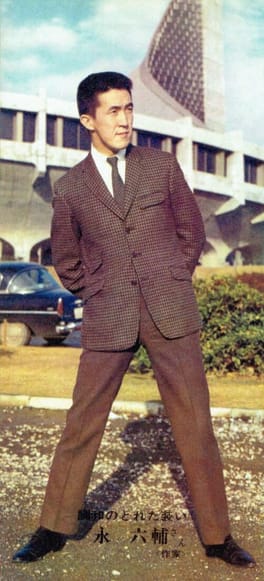
There is a song almost everyone can hum, even though few know who wrote it: "Ue wo Muite Aruko" — the bittersweet, head-tilted-upward walk through loneliness, sung so the tears won't spill.
The words were written by Rokusuke Ei. Born in Tokyo in 1933 and passing away in 2016, he was a lyricist, a broadcasting writer, a television and radio host, and an entertainer — a rare, many-sided figure who seemed to live several careers at once.
And his words, while his own name stayed largely unknown, crossed the ocean and reached the ears of people all over the world.
Born in Tokyo, Schooled at Waseda
Rokusuke Ei was born on April 10, 1933, in Tokyo. His zodiac sign was Aries and his eto was the Rooster. He later studied at Waseda University.
The era in which he grew up and rose to prominence coincided with the dawn of Japanese television and radio. He lived as a maker right at the scene where broadcasting — a brand-new medium — was taking root in society. Television host, lyricist, broadcasting writer, entertainer: his long list of titles is itself proof that he stood at the center of a moment when media was expanding at breathtaking speed.
The Song That Became "Sukiyaki"
What made Ei's name immortal was, above all, "Ue wo Muite Aruko." The song crossed the Pacific and, in 1963, reached number one on the U.S. Billboard chart under the bewildering title "Sukiyaki." It remains the only Japanese-language song ever to top the American chart.
When you stop to think about it, that's an extraordinary thing. People around the world hummed this melody and quietly lifted their faces, never knowing the name of the man who wrote the words. His genius lived in the simplicity: a few words, a single mood, the posture of looking up. That was all it took to move the world.
The Voice of a Wise, Mischievous Neighbor
Ei was not a one-song man. For decades afterward he kept speaking to Japan — as a broadcasting writer, as a radio host, as a constant, familiar voice.
That voice carried a little venom and plenty of charm at once. Listening to him come through the radio felt like trading neighborhood gossip with a wise, slightly mischievous older brother on the porch. He accomplished great things and yet never put on airs. That nearness, that lack of pretension, is exactly why people loved him for so long.
Wearing His Honors Lightly
In 2000, Ei received the Kikuchi Kan Prize, an award given to those who have made significant contributions to Japanese culture, publishing, and broadcasting — a firm recognition of his many years of work. He also received the Golden Arrow Award.
Yet for all these achievements, he never stiffened with self-importance. He wore his prizes and his fame as lightly as a jacket. To leave good work behind with style and an easy, unhurried grace — that, it seems, was simply Rokusuke Ei's way.
On July 7, 2016, Rokusuke Ei closed his life. But the song he left behind, "Ue wo Muite Aruko," is still being hummed somewhere in the world, still lifting someone's face upward.
To stay unknown by name and yet quietly turn people the whole world over toward hope — is there a richer legacy than that? He is the kind of man who makes you want to say: thank you, Ei-san, for all the good work.