The Man Who Declared "I Am the Strongest": How Shingo Kunieda Conquered Wheelchair Tennis
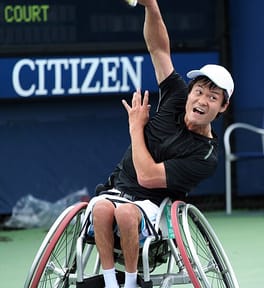
A small sticker was fixed to the frame of his racket. On it were just a few words: "I am the strongest." It is the kind of line most people would be too embarrassed to say aloud. Yet Shingo Kunieda kept it in his line of sight before every match, believed it with total conviction, and then went out and actually became the best in the world.
Kunieda did more than win. He lifted Japanese wheelchair tennis from an obscure, overlooked sport onto a stage the whole world watched. He lost the use of his legs at nine, picked up a racket at eleven, and finished his career holding a career Golden Slam — all four Grand Slam singles titles plus Paralympic gold. His story is not one of inherited talent. It is a story of will, rewritten one stroke at a time.
A Turning Point at Nine
Born on February 21, 1984, in Kashiwa, Chiba, Kunieda was an ordinary, active boy. Then, at age nine, he was diagnosed with a spinal tumor. After surgery, he began life in a wheelchair.
There is no ready answer for a child confronting the loss of his legs. But his life did not stop there. At eleven, he discovered wheelchair tennis. On the court, the wheelchair was not a handicap but simply one of the conditions he had to work with. The story of an athlete who would one day dominate the world began quietly, with that small encounter.
World No. 1 and a Calendar-Year Grand Slam
In 2004, the twenty-year-old Kunieda competed at the Athens Paralympics and won gold in doubles — his first summit on the world stage.
From there, his rise was relentless. In 2006 he became the first Asian player to reach world No. 1 in wheelchair tennis. The following year, in 2007, he achieved the first calendar-year Grand Slam in the history of the sport, sweeping all four singles majors in a single year. To win every elite tournament in twelve months is a feat few can imagine — and he did it while still in his early twenties, rewriting what the world thought possible for a Japanese athlete.
The Commitment of Turning Professional
In April 2009, Kunieda declared himself Japan's first professional wheelchair tennis player. He signed with UNIQLO, a partnership that would later see him serve for years as a Global Brand Ambassador.
The word "professional" carried real weight. In Japan at the time, making a living from wheelchair tennis alone was far from a given. His decision was for himself, but it was also a signpost for the players who would follow — proof that this path could sustain a life. In 2011 he married Ai Kunieda, and the foundation supporting both his life and his sport grew steadier.
Three Paralympic Golds and a Long-Awaited Wimbledon
At Beijing in 2008 and London in 2012, Kunieda claimed back-to-back singles gold medals. But even a champion faces shadows. An elbow injury troubled him around Rio, and there were stretches when the results did not come.
He did not break. In 2021, at the home Tokyo Paralympics, he won singles gold for the third time and served as captain of Japan's team — the very face of the country's para-sport. Then, in 2022, he finally won Wimbledon, the title that had eluded him for years. With it, he became the first wheelchair men's player to complete a career Golden Slam. His Grand Slam wheelchair titles total fifty — twenty-eight in singles, twenty-two in doubles — the most by any man in history, a number no one is likely to catch.
Between Fire and Humility
On court, Kunieda never hid his burning competitiveness. The "I am the strongest" sticker came from a lesson with a mental trainer and became his guiding motto. Believing utterly in your own strength was not arrogance but a tool — something to lean on in the most extreme moments.
Yet when he announced his retirement in 2023, what he spoke of was not the tally of victories. "Being able to keep loving wheelchair tennis is what made me happy." The man who had craved winning so fiercely closed with a pure love of the game. That gap between fire and humility is exactly why so many people were drawn to him.
A wheelchair at nine, a racket at eleven, the summit of the world at the end. It is startling that reality wrote a script this dramatic. But the heart of his story lies not in the circumstances he was handed — it lies in the will that turned them into "strongest."
In 2024, Kunieda became a specially appointed professor at his alma mater, Reitaku University. Even away from the court, what he is trying to pass to the next generation is more than technique. It is the simple fact that even from a place full of reasons to look down, a person can stand at the top of the world.