The Man Who Never Put Down the Cushion: Shofukutei Tsurube and the Art of Loving People
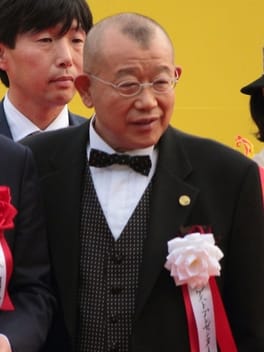
Turn on a Japanese television and that crinkly, unmistakable smile is bound to be somewhere on the dial. On a daytime variety show, on the porch of a stranger's house, in a late-night studio, he is always laughing the same laugh. But behind that grin runs a single, unbending thread that has held steady for more than half a century.
"I'm on television, but I'm a rakugo storyteller." That is how Shofukutei Tsurube describes himself, every time. Famous across the country as a talent, an actor, and a host, the one thing he never let go of was a single floor cushion on the rakugo stage.
How did a young man named Manabu Suruga, born in Hirano Ward, Osaka, become a byword for the person who simply loves human beings? His path reads like a long performance, laughter and tenderness arriving in turns.
From Kyoto Student to Shokaku's Eleventh Disciple
He was born Manabu Suruga on December 23, 1951, in Nagayoshi Village, Nakakawachi District, Osaka, now part of Hirano Ward. He went from Osaka Prefectural Naniwa High School to the Faculty of Economics at Kyoto Sangyo University, but it was not economics that held him. It was rakugo. The hours he spent in his school and university storytelling clubs decided the whole shape of his life.
He withdrew from university and, in February 1972, became an apprentice to the sixth-generation Shofukutei Shokaku. As Shokaku's eleventh disciple he received the stage name Shofukutei Tsurube and registered that same year with the Kamigata Rakugo Association. Under the famously bold master Shokaku, he stepped into the world of Kamigata rakugo and never looked back.
The Boundless Warmth Television Discovered
After joining Shochiku Entertainment in 1974, Tsurube's stage grew far beyond the rakugo hall. In the 1980s, television could not leave his extraordinary gift for people alone.
In 1987 he became a regular on Fuji TV's beloved daytime show Waratte Iitomo!, and that same year Tsurube Ueka Papepo TV began, an unscripted program built entirely on improvised talk between Tsurube and Ryutaro Ueka. It produced countless famous lines and became a Kansai legend. Then, in 1996, NHK's Tsurube no Kazoku ni Kanpai went on the air. He would wander into unfamiliar towns, knock on strangers' doors, and before long be eating dinner in their kitchen as if he belonged there. It looks like anyone could do it, yet no one else can, and it stamped him into living rooms across Japan.
Carrying the Cushion onto the Screen
While he spread laughter on television, Tsurube was quietly sharpening another craft: acting.
In 2009 he starred in Miwa Nishikawa's Dear Doctor and won the Outstanding Lead Actor award at the 33rd Japan Academy Prize. The following year he took the same award for Yoji Yamada's Ototo. In 2014 came Outstanding Supporting Actor for Fushigi na Misaki no Monogatari, and in 2019 Outstanding Lead Actor again for Heisa Byoto: Sorezore no Asa, a film that also earned him Best Actor in a Foreign Language Film at China's Golden Rooster and Hundred Flowers Festival.
On screen he sheds the cheerfulness audiences know and becomes a quiet, shadowed ordinary man. The technique to make people laugh and the technique to make them cry in silence, moving freely between the two, is exactly what makes Tsurube formidable as an actor.
The Resolve to Walk Under His Own Name
In 1999 he founded Denner Systems, later Denner Co., Ltd., building his own footing while keeping a concurrent affiliation with Shochiku Entertainment. His first son, Taro Suruga, born to him and his wife Reiko, whom he married in 1973, became an actor in his own right, father and son both walking the path of performance.
From 2013 he hosted TBS's A-Studio, finding fresh ground as an interviewer who gently drew out the real faces of his guests. He received the Minister of Education's Art Encouragement Prize in 2019 and the NHK Broadcasting Culture Award in 2020. As a rakugo artist, as an actor, and as a host, he has remained first-rate under every title, a rare path indeed.
If you had to sum up Shofukutei Tsurube in a single phrase, it would surely be this: a man who loves human beings. He barges into a stranger's home and somehow leaves part of the family. He turns quiet on screen and gently loosens the viewer's tears.
A darling of television who carried his cushion to the very end. He makes you laugh, makes you ache, and always closes with warmth. Among the many entertainers Osaka has produced, few have kept the act of facing other people so firmly at the center of their craft. The titles have multiplied, but the thread runs as straight as ever, still belonging to the young man who once called himself Mugaku.