Covering the Universe in Dots: Yayoi Kusama's Lifelong Obsession
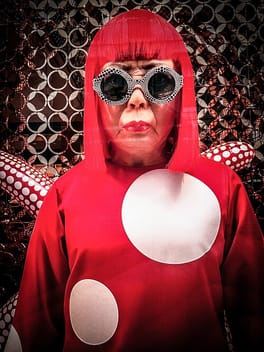
A fire-red bob, a polka-dot dress, and no smile. Yayoi Kusama overwhelmed everyone who met her gaze.
Born into a seed-merchant family in Matsumoto, Nagano, the young girl was tormented from childhood by hallucinations — countless dots that filled her field of vision. But rather than be swallowed by them, she chose to capture them on canvas. That choice became the origin of an "infinite proliferation" that would one day cover the world.
This is the story of a woman who transformed her hallucinations into art and ran at the forefront of the avant-garde for more than half a century.
The Girl Who Turned Hallucinations Into Paintings
Born in 1929, Kusama grew up in a household that was far from peaceful. She was born into a wealthy family that ran a seed and nursery business. Through it all, what sustained the young girl was drawing.
Transferring the hallucinations and auditory experiences she had known since childhood onto the canvas became the root of her art. In 1945, at age sixteen, she was selected for the 1st All-Shinshu Art Exhibition. After studying Japanese painting at the Kyoto Municipal School of Arts and Crafts, she held her first solo exhibition in Matsumoto in 1952. A girl from the provinces had already begun painting a world entirely her own.
Crossing the Ocean to the New York Avant-Garde
Before leaving Japan, Kusama mailed letters to the painter she admired, Georgia O'Keeffe. The sheer boldness of writing to a master on the other side of the world embodied the way she would live her life.
In 1957, Kusama moved to the United States. She held her first American solo show in Seattle, then relocated to New York. In 1959, the Infinity Net paintings she unveiled at Brata Gallery — canvases filled edge to edge with repeating net patterns — made her name almost overnight. Plunging into the heart of 1960s New York, she pushed the avant-garde even further than the avant-garde. By 1966, she had appeared at the Venice Biennale.
Through Illness, Still Painting
In 1973, her health broke down and she returned to Japan, where she was hospitalized. From then on Tokyo was her base, and she never stopped creating.
Living with hallucinations while continually sublimating them into art: this way of life is inseparable from her work.
Dots and Pumpkins, a Global Trademark
Kusama's name became synonymous with endlessly multiplying polka dots and her playful pumpkins. Her Infinity Mirror Rooms, lined with mirrors that reflect points of light into infinity, became immersive installations that draw long lines at museums around the world.
In 1993, she presented the first solo exhibition in the Japanese Pavilion at the Venice Biennale, cementing her international standing as a representative of Japanese art. In 1999, the exhibition Yayoi Kusama: New York/Tokyo was held at the Museum of Contemporary Art Tokyo. Collaborations with Louis Vuitton in 2012 and 2023 carried her dots far beyond the art world.
Not Only a Painter, but a Writer
Kusama was a painter and sculptor, but also a writer of novels and poetry. In 1983, her novel Christopher's Male Brothel won the Yasei Jidai New Writer Literary Prize. In 2002, she published her autobiography, Infinity Net.
Her achievements have been recognized with many honors: the Praemium Imperiale in 2006, the designation of Person of Cultural Merit in 2009, and Japan's Order of Culture in 2016 — the same year she was named one of TIME magazine's 100 Most Influential People in the World. In 2017, the Yayoi Kusama Museum opened in Shinjuku, Tokyo, creating a place where her universe can be experienced firsthand.
Most people might be satisfied once a single trend lands. Not Yayoi Kusama. As if to say "it's still not enough, multiply it to infinity," she has covered canvases, rooms, and mirrors — every conceivable space — in dots.
Across a life of nearly a century she ran at the very front of the avant-garde. A girl who suffered from hallucinations turned that suffering into art the world goes wild for. Yayoi Kusama's infinite proliferation lives on in her work.