The Man With a Library of Pitches: How Yu Darvish Rewrote Two Decades of Baseball
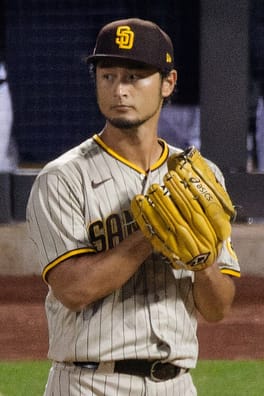
Born on August 16, 1986, in Habikino, Osaka, to an Iranian father and a Japanese mother, Yu Darvish would grow into a towering 196-centimeter frame and become, on both sides of the Pacific, what people simply call an ace.
Yet what makes him singular is neither his height nor his velocity. It is the sheer number of breaking pitches he commands, arranged as neatly as drawers in a stationery shop, and his bottomless curiosity about his own body, which he treats as a subject of permanent study.
This is the story of a pitcher who walked straight from high school into professional baseball and spent the next twenty years carving his name into the histories of two countries.
From Habikino to the Draft
Darvish grew up in Habikino, Osaka, and attended Tohoku High School in Miyagi Prefecture. He never went to university. In 2004, the moment he graduated, the Hokkaido Nippon-Ham Fighters selected him in the first round of the draft, and he stepped into the world of professional baseball.
Being the top pick carries expectation and pressure in equal measure, but Darvish turned that weight into fuel. Just two years after joining, in 2006, he helped the Fighters win the Japan Series. A player barely out of his teens stood at the very top of the Japanese game.
A 21-Year-Old Ace Sweeps the Awards
In 2007, Darvish surged to the summit. He claimed the Pacific League MVP, the Sawamura Award given to Japan's finest pitcher, the strikeout title, a Golden Glove, and a Best Nine selection, gathering nearly every major honor in a single season.
He was 21. His MVP ranked among the youngest in league history at the time. That he also earned a Golden Glove for his defense signaled something important: he was not merely a power arm but a player who understood the game at a high level. In 2009 he won the Pacific League MVP and ERA title once more, cementing his place in Japanese baseball.
Crossing the Pacific
Having achieved all he could in Japan, Darvish was posted to the Texas Rangers in 2012 and arrived in Major League Baseball. From his very first season he anchored the rotation, proving again that a Japanese pitcher could thrive in the world's toughest league.
The road that followed was far from smooth. In 2017 he moved to the Los Angeles Dodgers and reached the World Series stage; the next year he joined the Chicago Cubs. Through every change of jersey, he remained at the heart of the rotation.
A Japanese First, and a World Title
In 2020, Darvish led MLB in wins, the first Japanese pitcher ever to do so. In 2021 he joined the San Diego Padres and was selected to the All-Star team that same year.
Then, in 2023, he wore the colors of Samurai Japan at the World Baseball Classic and became one of the figures behind Japan reclaiming the world title. As a veteran steadying a younger pitching staff, he had clearly outgrown the role of mere pitcher. In 2024 he reached 200 combined wins across NPB and MLB and 2,000 MLB strikeouts, milestones that placed him in Japanese baseball history on both counts.
Turning His Own Body Into a Laboratory
You cannot describe Darvish without his arsenal. Where most pitchers get by on two or three offerings, he commands well over ten different pitches and has kept adding new ones well into his thirties.
He shares what he learns generously with younger pitchers, teaching them his pitches at the 2023 World Baseball Classic. The analytical mind and the caretaker's warmth live side by side in him.
The young man who leapt from high school into the pros spent two decades setting records at the highest levels of both Japanese and American baseball. But the essence of Darvish lies not in the number of titles he has won; it lies in his refusal to stop studying himself.
A pitcher from Osaka, carrying within a 196-centimeter frame a library of breaking balls and an inexhaustible curiosity. His inquiry, even now, continues on the mound.