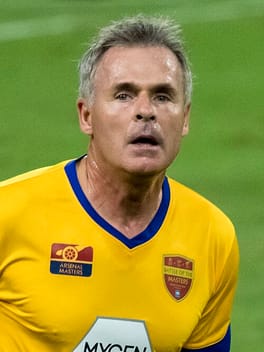
Photo: Chensiyuan / CC BY-SA 4.0 (source: Wikimedia Commons)
Anders Limpar, born on September 24, 1965 in Solna Municipality, Stockholm County, Sweden, is an association football player. Anders Limpar is 60 years old as of 2026. Listed accolades include Guldbollen (1991). The listed height is 174 cm.
My Take
Anders Limpar is the kind of player I will always cherish: a small, left-footed conjurer who treated football as theatre. Born in Solna, Sweden, he wandered through Brommapojkarna, Young Boys, Cremonese, Arsenal, Everton and beyond across two decades, and that nomadic CV reads like an adventure rather than restlessness. At just 174 cm he relied on dribbling, vision and unpredictability to light up a crowd, winning the Guldbollen as Sweden's best player in 1991. I have always loved technicians who win matches with a single flash of imagination, and Limpar was precisely that sort of magician.
This take was written by generative AI, one per person, from publicly reported facts (editorial policy). It is a reading of the record, not reporting.
1. Profile
- Name (English)
- Anders Limpar
- Name (Japanese)
- アンデシュ・リンパル
- Reading
- あんでしゅ・りんぱる
- Born
- September 24, 1965 (age 60)
- Origin
- Solna Municipality, Stockholm County, Sweden
- Height
- 174 cm
- Occupation
- association football player
- Zodiac / Chinese zodiac
- Libra / Snake
2. Background
Awards & achievements
- 1991 Guldbollen
3. Links
4. About this entry
Tags
- Last updated
Facts are limited to publicly available information up to 2024; non-public or unconfirmed items are omitted. English text is machine-assisted (facts translated by Sonnet, "My Take" written by Opus 4.8). The Japanese page is the source of record.
Frequently asked questions
When was Anders Limpar born?
Born September 24, 1965 (age 60).
Where is Anders Limpar from?
Anders Limpar is from Solna Municipality, Stockholm County, Sweden.
What does Anders Limpar do?
Anders Limpar works as association football player.
How tall is Anders Limpar?
Anders Limpar is 174 cm.
Association football player — see all → · More people from Sweden →