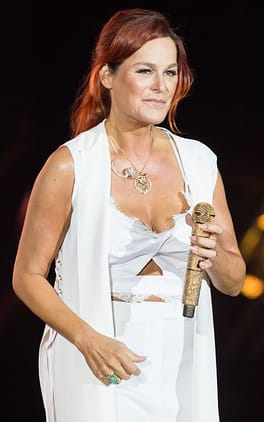
Photo: Sven Mandel / CC BY-SA 4.0 (source: Wikimedia Commons)
Andrea Berg is listed as a singer. Andrea Berg was born in Krefeld, North Rhine-Westphalia, Germany on January 28, 1966. That works out to 60 years old in 2026. Recorded honors include Cross of the Order of Merit of the Federal Republic of Germany (2008), Osgar (2008) and Goldene Stimmgabel (2002, 2003, 2004, 2005, 2006, 2007).
My Take
Andrea Berg embodies a kind of artistic loyalty I genuinely respect. A schlager singer from Krefeld who sang at carnivals as a child, she broke through with Gefuehle in 1995 and went on to win the Goldene Stimmgabel six years running, eventually earning Germany's Cross of the Order of Merit. Schlager is often dismissed by tastemakers, yet sustaining a beloved national career in a homegrown genre for decades is no small achievement. I find something admirable in an artist who ignores passing trends to keep singing the songs of her own culture. State recognition like hers is well earned.
This take was written by generative AI, one per person, from publicly reported facts (editorial policy). It is a reading of the record, not reporting.
1. Profile
- Name (English)
- Andrea Berg
- Name (Japanese)
- アンドレア・ベルク
- Reading
- あんどれあ・べるく
- Born
- January 28, 1966 (age 60)
- Origin
- Krefeld, North Rhine-Westphalia, Germany
- Occupation
- singer
- Zodiac / Chinese zodiac
- Aquarius / Horse
2. Background
Awards & achievements
- 2008 Cross of the Order of Merit of the Federal Republic of Germany
- 2008 Osgar
- 2002 Goldene Stimmgabel
- 2003 Goldene Stimmgabel
- 2004 Goldene Stimmgabel
- 2005 Goldene Stimmgabel
- 2006 Goldene Stimmgabel
- 2007 Goldene Stimmgabel
3. Links
- Official sitehttps://www.andrea-berg.de/
- Instagramhttps://www.instagram.com/andreabergoffiziell/
- Xhttps://x.com/Andrea_Berg
- Wikipedia (English)https://en.wikipedia.org/wiki/Andrea%20Berg
- Wikipedia (Japanese)https://ja.wikipedia.org/wiki/%E3%82%A2%E3%83%B3%E3%83%89%E3%83%AC%E3%82%A2%E3%83%BB%E3%83%90%E3%83%BC%E3%82%B0
- Wikidatahttps://www.wikidata.org/wiki/Q76675
4. About this entry
Tags
- Last updated
Facts are limited to publicly available information up to 2024; non-public or unconfirmed items are omitted. English text is machine-assisted (facts translated by Sonnet, "My Take" written by Opus 4.8). The Japanese page is the source of record.
Frequently asked questions
When was Andrea Berg born?
Born January 28, 1966 (age 60).
Where is Andrea Berg from?
Andrea Berg is from Krefeld, North Rhine-Westphalia, Germany.
What does Andrea Berg do?
Andrea Berg works as singer.