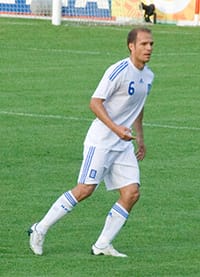
Photo: Stelios Tsaousidis, stelios@acebit.com / Public domain (source: Wikimedia Commons)
Born on January 3, 1976, Angelos Basinas is from Chalkída, Euboea regional unit, Greece. Public records list Angelos Basinas as an association football player. The age as of 2026 is 50. The listed height is 178 cm.
My Take
For me, Angelos Basinas is shorthand for one of football's great miracles. The defensive midfielder from Chalkída was a vital cog in the Greece side that stunned everyone to win Euro 2004, the kind of player whose value lives in interceptions and tempo rather than highlight reels. That tournament rewrote what an organised, fearless underdog could achieve, and he was right in the engine room of it. I'm also intrigued that he stayed in the game as sporting director at Iraklis, turning a player's hard-won instincts into administration. I have deep respect for the unsung professionals who tilt history.
This take was written by generative AI, one per person, from publicly reported facts (editorial policy). It is a reading of the record, not reporting.
1. Profile
- Name (English)
- Angelos Basinas
- Name (Japanese)
- アンゲロス・バシナス
- Reading
- あんげろす・ばしなす
- Born
- January 3, 1976 (age 50)
- Origin
- Chalkída, Euboea regional unit, Greece
- Height
- 178 cm
- Occupation
- association football player
- Zodiac / Chinese zodiac
- Capricorn / Dragon
2. Links
3. About this entry
Tags
- Last updated
Facts are limited to publicly available information up to 2024; non-public or unconfirmed items are omitted. English text is machine-assisted (facts translated by Sonnet, "My Take" written by Opus 4.8). The Japanese page is the source of record.
Frequently asked questions
When was Angelos Basinas born?
Born January 3, 1976 (age 50).
Where is Angelos Basinas from?
Angelos Basinas is from Chalkída, Euboea regional unit, Greece.
What does Angelos Basinas do?
Angelos Basinas works as association football player.
How tall is Angelos Basinas?
Angelos Basinas is 178 cm.
Association football player — see all → · More people from Greece →