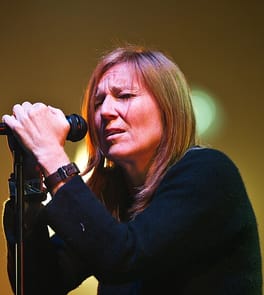
Photo: Bill Ebbesen / CC BY-SA 3.0 (source: Wikimedia Commons)
Beth Gibbons was born on January 4, 1965 in Exeter, United Kingdom and is credited as a singer, songwriter and musician. That puts Beth Gibbons at 61 years old in 2026. Awards on record include Libera Award for Best Classical Record.
My Take
Beth Gibbons has one of the most haunting voices in modern music, full stop. As the singer and lyricist of Portishead, she essentially defined the aching, smoky sound of trip-hop on Dummy, and that record still gives me chills decades later. What I admire most is her fearless refusal to repeat herself, from the gorgeous folk of Out of Season with Rustin Man to her stunning, deeply committed recording of Gorecki's Symphony No. 3. The English singer is famously private and rare, which only makes each release feel like an event. When she finally went solo, it confirmed she's an artist of extraordinary, uncompromising depth.
This take was written by generative AI, one per person, from publicly reported facts (editorial policy). It is a reading of the record, not reporting.
1. Profile
- Name (English)
- Beth Gibbons
- Name (Japanese)
- ベス・ギボンズ
- Reading
- べす・ぎぼんず
- Born
- January 4, 1965 (age 61)
- Origin
- Exeter, United Kingdom
- Occupation
- singer / songwriter / musician / Liedermacher
- Zodiac / Chinese zodiac
- Capricorn / Snake
2. Background
Awards & achievements
- Libera Award for Best Classical Record
3. Links
- Official sitehttps://bethgibbons.net/
- Instagramhttps://www.instagram.com/officialbethgibbons/
- Xhttps://x.com/realbethgibbons
- Wikipedia (English)https://en.wikipedia.org/wiki/Beth%20Gibbons
- Wikipedia (Japanese)https://ja.wikipedia.org/wiki/%E3%83%99%E3%82%B9%E3%83%BB%E3%82%AE%E3%83%9C%E3%83%B3%E3%82%BA
- Wikidatahttps://www.wikidata.org/wiki/Q233264
4. About this entry
Tags
- Last updated
Facts are limited to publicly available information up to 2024; non-public or unconfirmed items are omitted. English text is machine-assisted (facts translated by Sonnet, "My Take" written by Opus 4.8). The Japanese page is the source of record.
Frequently asked questions
When was Beth Gibbons born?
Beth Gibbons was born on January 4, 1965 and is 61 years old.
Where is Beth Gibbons from?
Beth Gibbons is from Exeter, United Kingdom.
What does Beth Gibbons do?
Beth Gibbons works as singer, songwriter, musician, Liedermacher.
Singer — see all → · Songwriter — see all → · More people from the United Kingdom → · More people born on January 4 →