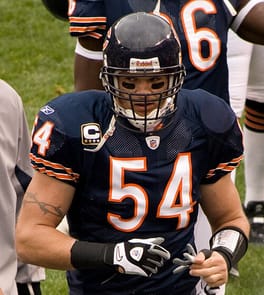
Photo: Brian_Urlacher.jpg: Jauerback derivative work: Papa Lima Whiskey (talk) / CC BY-SA 3.0 (source: Wikimedia Commons)
Brian Urlacher is listed as an American football player. Brian Urlacher was born on May 25, 1978 in Pasco, Washington, United States. That works out to 48 years old in 2026. Education on record includes Lovington High School and University of New Mexico. Listed accolades include Pro Football Hall of Fame.
My Take
Brian Urlacher earns my respect for a quality the modern game rarely rewards: loyalty. Out of Pasco, Washington, by way of New Mexico, he spent all thirteen NFL seasons with the Chicago Bears and walked into the Hall of Fame. In an era of constant movement, becoming synonymous with one franchise is its own kind of greatness. At 193 cm he physically dominated, but what I find compelling is the commitment to a single city and crest. Number 54 stopped being a jersey and became shorthand for Chicago itself. That sort of rootedness is harder to build than raw talent.
This take was written by generative AI, one per person, from publicly reported facts (editorial policy). It is a reading of the record, not reporting.
1. Profile
- Name (English)
- Brian Urlacher
- Name (Japanese)
- ブライアン・アーラッカー
- Reading
- ぶらいあん・あーらっかー
- Born
- May 25, 1978 (age 48)
- Origin
- Pasco, Washington, United States
- Height
- 193 cm
- Occupation
- American football player
- Zodiac / Chinese zodiac
- Gemini / Horse
2. Background
- High school
- Lovington High School
- University
- University of New Mexico
Awards & achievements
- Pro Football Hall of Fame
3. Links
- Official sitehttp://www.brianurlacher.com
- Instagramhttps://www.instagram.com/54urlacher/
- Xhttps://x.com/BUrlacher54
- Wikipedia (English)https://en.wikipedia.org/wiki/Brian%20Urlacher
- Wikipedia (Japanese)https://ja.wikipedia.org/wiki/%E3%83%96%E3%83%A9%E3%82%A4%E3%82%A2%E3%83%B3%E3%83%BB%E3%82%A2%E3%83%BC%E3%83%A9%E3%83%83%E3%82%AB%E3%83%BC
- Wikidatahttps://www.wikidata.org/wiki/Q471841
4. About this entry
Tags
- Last updated
Facts are limited to publicly available information up to 2024; non-public or unconfirmed items are omitted. English text is machine-assisted (facts translated by Sonnet, "My Take" written by Opus 4.8). The Japanese page is the source of record.
Frequently asked questions
When was Brian Urlacher born?
Born May 25, 1978 (age 48).
Where is Brian Urlacher from?
Brian Urlacher is from Pasco, Washington, United States.
What does Brian Urlacher do?
Brian Urlacher works as American football player.
How tall is Brian Urlacher?
Brian Urlacher is 193 cm.
American football player — see all → · More people from the United States →