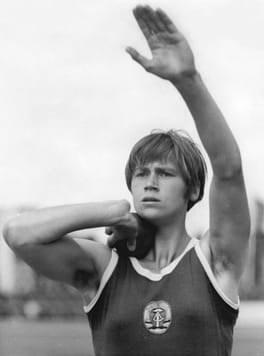
Photo: Helmut Schaar / CC BY-SA 3.0 de (source: Wikimedia Commons)
Burglinde Pollak, born on June 10, 1951 in Werder (Havel), Brandenburg, Germany, is an athletics competitor. That puts Burglinde Pollak at 75 years old in 2026. The listed height is 179 cm.
My Take
Burglinde Pollak's career reads like a study in versatility and grit. Three world records and Olympic bronze in both 1972 and 1976, all in the pentathlon, where you have to master five disparate disciplines rather than perfect one. That breadth impresses me far more than a single specialty ever could. What I find most compelling, though, is her second act: trading the demands of elite sport for a physiotherapy practice of her own. An athlete who pushed her body to its limits then devoted herself to healing others has a rare narrative symmetry. She strikes me as someone who understood the body completely, from both sides.
This take was written by generative AI, one per person, from publicly reported facts (editorial policy). It is a reading of the record, not reporting.
1. Profile
- Name (English)
- Burglinde Pollak
- Name (Japanese)
- ブルクリンデ・ポラック
- Reading
- ぶるくりんで・ぽらっく
- Born
- June 10, 1951 (age 75)
- Origin
- Werder (Havel), Brandenburg, Germany
- Height
- 179 cm
- Occupation
- athletics competitor
- Zodiac / Chinese zodiac
- Gemini / Rabbit
2. Links
3. About this entry
Tags
- Last updated
Facts are limited to publicly available information up to 2024; non-public or unconfirmed items are omitted. English text is machine-assisted (facts translated by Sonnet, "My Take" written by Opus 4.8). The Japanese page is the source of record.
Frequently asked questions
When was Burglinde Pollak born?
Born June 10, 1951 (age 75).
Where is Burglinde Pollak from?
Burglinde Pollak is from Werder (Havel), Brandenburg, Germany.
What does Burglinde Pollak do?
Burglinde Pollak works as athletics competitor.
How tall is Burglinde Pollak?
Burglinde Pollak is 179 cm.
Athletics competitor — see all → · More people from Germany →