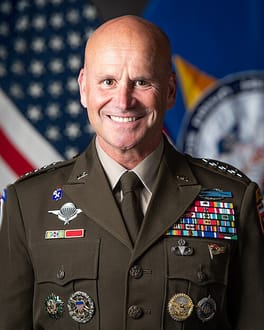
Photo: U.S. European Command / Public domain (source: Wikimedia Commons)
Public records list Christopher G. Cavoli as an army officer. Christopher G. Cavoli was educated at Yale University. Awards on record include Combat Infantryman Badge, Legion of Merit, Pathfinder Badge and 1 more.
My Take
Christopher Cavoli fascinates me as a soldier-scholar who reached the very top. Born in Würzburg, educated at Yale, and ultimately Supreme Allied Commander Europe, he bridges the battlefield and the briefing room. The Combat Infantryman Badge alongside the Legion of Merit and the Bavarian Order of Merit suggests a man equally credible in mud and in diplomacy. I am drawn to that combination of intellect and field-tested judgment. He carries the weight of European security with little fanfare, and to me that quiet, accountable seriousness is far more impressive than any showmanship.
This take was written by generative AI, one per person, from publicly reported facts (editorial policy). It is a reading of the record, not reporting.
1. Profile
- Name (English)
- Christopher G. Cavoli
- Name (Japanese)
- クリストファー・G・カヴォリ
- Reading
- くりすとふぁー・G・かゔぉり
- Born
- 1964
- Origin
- Würzburg, Lower Franconia, Germany
- Occupation
- army officer
- Zodiac / Chinese zodiac
- Dragon
2. Background
- University
- Yale University
Awards & achievements
- Combat Infantryman Badge
- Legion of Merit
- Pathfinder Badge
- Bavarian Order of Merit
3. Links
- Wikipedia (English)https://en.wikipedia.org/wiki/Christopher%20G.%20Cavoli
- Wikidatahttps://www.wikidata.org/wiki/Q47463631
4. About this entry
Tags
- Last updated
Facts are limited to publicly available information up to 2024; non-public or unconfirmed items are omitted. English text is machine-assisted (facts translated by Sonnet, "My Take" written by Opus 4.8). The Japanese page is the source of record.
Frequently asked questions
Where is Christopher G. Cavoli from?
Christopher G. Cavoli is from Würzburg, Lower Franconia, Germany.
What does Christopher G. Cavoli do?
Christopher G. Cavoli works as army officer.
Where did Christopher G. Cavoli study?
Christopher G. Cavoli attended Yale University.