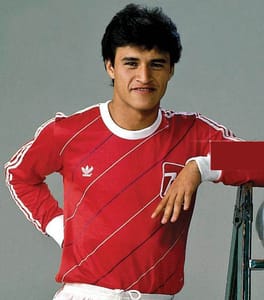
Photo: Unknown author / Public domain (source: Wikimedia Commons)
Claudio Borghi is an association football player and association football coach, born on September 28, 1964 in Castelar, Buenos Aires Province, Argentina. That puts Claudio Borghi at 61 years old in 2026. The listed height is 181 cm.
My Take
Claudio Borghi, affectionately known as Bichi, is the kind of footballer I find quietly fascinating. An attacking midfielder from the outskirts of Buenos Aires, he did not stay put: he played across Argentina, Chile, Italy, Switzerland, Brazil and Mexico, then coached as far afield as Ecuador. That restless itinerary tells me he had both the adaptability to thrive anywhere and an open, inventive football mind. At 181 cm he likely shaped play rather than just chased it. I have a soft spot for these border-crossing journeymen of the game, careers stitched together across continents, carrying ideas wherever they land.
This take was written by generative AI, one per person, from publicly reported facts (editorial policy). It is a reading of the record, not reporting.
1. Profile
- Name (English)
- Claudio Borghi
- Name (Japanese)
- クラウディオ・ボルギ
- Reading
- くらうでぃお・ぼるぎ
- Born
- September 28, 1964 (age 61)
- Origin
- Castelar, Buenos Aires Province, Argentina
- Height
- 181 cm
- Occupation
- association football player / association football coach
- Zodiac / Chinese zodiac
- Libra / Dragon
2. Links
3. About this entry
Tags
- Last updated
Facts are limited to publicly available information up to 2024; non-public or unconfirmed items are omitted. English text is machine-assisted (facts translated by Sonnet, "My Take" written by Opus 4.8). The Japanese page is the source of record.
Frequently asked questions
When was Claudio Borghi born?
Born September 28, 1964 (age 61).
Where is Claudio Borghi from?
Claudio Borghi is from Castelar, Buenos Aires Province, Argentina.
What does Claudio Borghi do?
Claudio Borghi works as association football player, association football coach.
How tall is Claudio Borghi?
Claudio Borghi is 181 cm.
Association football player — see all → · Association football coach — see all → · More people from Argentina →