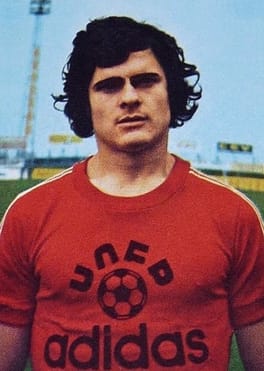
Photo: Panini / Public domain (source: Wikimedia Commons)
Born on August 21, 1954, Didier Six is from Lille, Nord, France. Didier Six is an association football player and association football coach. The age as of 2026 is 72. The listed height is 179 cm.
My Take
Didier Six is the kind of footballer I find irresistibly romantic: a gifted but inconsistent winger who roamed through five countries yet still climbed to the very top with France. He featured at the 1978 and 1982 World Cups and was part of the triumphant Euro 84 squad, proving that flair and fragility can coexist in the same player. That honest description, brilliant on his day and frustrating on others, makes him feel human in a way modern profiles rarely do. He kept the flame burning into management too, leading Guinea until 2021. I love this beautifully unpredictable career.
This take was written by generative AI, one per person, from publicly reported facts (editorial policy). It is a reading of the record, not reporting.
1. Profile
- Name (English)
- Didier Six
- Name (Japanese)
- ディディエ・シクス
- Reading
- でぃでぃえ・しくす
- Born
- August 21, 1954 (age 72)
- Origin
- Lille, Nord, France
- Height
- 179 cm
- Occupation
- association football player / association football coach
- Zodiac / Chinese zodiac
- Leo / Horse
2. Links
3. About this entry
Tags
- Last updated
Facts are limited to publicly available information up to 2024; non-public or unconfirmed items are omitted. English text is machine-assisted (facts translated by Sonnet, "My Take" written by Opus 4.8). The Japanese page is the source of record.
Frequently asked questions
When was Didier Six born?
Born August 21, 1954 (age 72).
Where is Didier Six from?
Didier Six is from Lille, Nord, France.
What does Didier Six do?
Didier Six works as association football player, association football coach.
How tall is Didier Six?
Didier Six is 179 cm.
Association football player — see all → · Association football coach — see all → · More people from France →