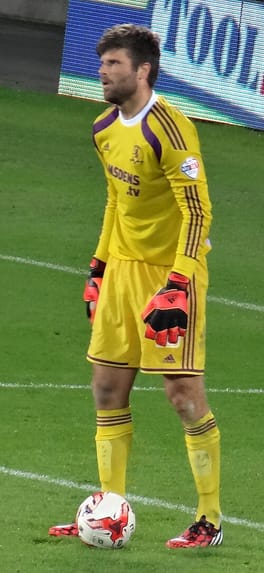
Photo: Jon Candy from Cardiff, Wales / CC BY-SA 2.0 (source: Wikimedia Commons)
Born on November 29, 1978, Dimitris Konstantopoulos is from Thessaloniki, Greece. Dimitris Konstantopoulos is listed as an association football player and association football coach. The age as of 2026 is 47. The listed height is 193 cm.
My Take
What draws me to Konstantopoulos is the slow-burn arc of his career. A 193cm keeper out of Thessaloniki who started in amateur ranks and racked up only a handful of appearances early on, he is the kind of player whose persistence I quietly admire far more than overnight talent. Goalkeeping rewards patience and nerve, and the fact that he later moved into coaching tells me his bond with the game ran deeper than personal glory. I see him as a craftsman who earned everything the hard way, and that backstory makes me root for him more than any highlight reel ever could.
This take was written by generative AI, one per person, from publicly reported facts (editorial policy). It is a reading of the record, not reporting.
1. Profile
- Name (English)
- Dimitris Konstantopoulos
- Name (Japanese)
- ディミトリオス・コンスタントプーロス
- Reading
- でぃみとりおす・こんすたんとぷーろす
- Born
- November 29, 1978 (age 47)
- Origin
- Thessaloniki, Greece
- Height
- 193 cm
- Occupation
- association football player / association football coach
- Zodiac / Chinese zodiac
- Sagittarius / Horse
2. Links
- Xhttps://x.com/Dimster23
- Wikipedia (English)https://en.wikipedia.org/wiki/Dimitris%20Konstantopoulos
- Wikipedia (Japanese)https://ja.wikipedia.org/wiki/%E3%83%87%E3%82%A3%E3%83%9F%E3%83%88%E3%83%AA%E3%82%AA%E3%82%B9%E3%83%BB%E3%82%B3%E3%83%B3%E3%82%B9%E3%82%BF%E3%83%B3%E3%83%88%E3%83%97%E3%83%BC%E3%83%AD%E3%82%B9
- Wikidatahttps://www.wikidata.org/wiki/Q2736626
3. About this entry
Tags
- Last updated
Facts are limited to publicly available information up to 2024; non-public or unconfirmed items are omitted. English text is machine-assisted (facts translated by Sonnet, "My Take" written by Opus 4.8). The Japanese page is the source of record.
Frequently asked questions
When was Dimitris Konstantopoulos born?
Born November 29, 1978 (age 47).
Where is Dimitris Konstantopoulos from?
Dimitris Konstantopoulos is from Thessaloniki, Greece.
What does Dimitris Konstantopoulos do?
Dimitris Konstantopoulos works as association football player, association football coach.
How tall is Dimitris Konstantopoulos?
Dimitris Konstantopoulos is 193 cm.
Association football player — see all → · Association football coach — see all → · More people from Greece →