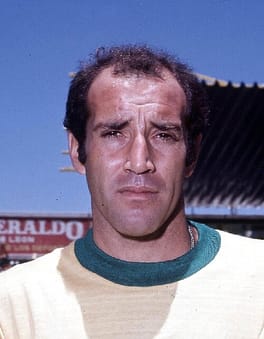
Photo: Rolls Press / Popperfoto / Getty Images / Public domain (source: Wikimedia Commons)
Gérson is an association football player and journalist, born on January 11, 1941 in Niterói, Rio de Janeiro, Brazil. As of 2026, Gérson is 85 years old. The listed height is 170 cm.
My Take
For a football lover, Gérson's name alone is a thrill. He was the cerebral heartbeat of Brazil's 1970 World Cup side, often called the greatest team ever assembled. At 170 cm he was never imposing, yet he governed the midfield with vision and a precise left foot, moving across Flamengo, Botafogo, São Paulo and Fluminense. I love that he later became a journalist, turning to describe the game in words after mastering it with his feet. He is the man whose name surfaces whenever that legendary yellow shirt is discussed, and to me that is pure footballing immortality.
This take was written by generative AI, one per person, from publicly reported facts (editorial policy). It is a reading of the record, not reporting.
1. Profile
- Name (English)
- Gérson
- Name (Japanese)
- ジェルソン・デ・オリヴェイラ・ヌーネス
- Reading
- じぇるそん・で・おりゔぇいら・ぬーねす
- Born
- January 11, 1941 (age 85)
- Origin
- Niterói, Rio de Janeiro, Brazil
- Height
- 170 cm
- Occupation
- association football player / journalist
- Zodiac / Chinese zodiac
- Capricorn / Snake
2. Links
- Wikipedia (English)https://en.wikipedia.org/wiki/G%C3%A9rson
- Wikipedia (Japanese)https://ja.wikipedia.org/wiki/%E3%82%B8%E3%82%A7%E3%83%AB%E3%82%BD%E3%83%B3%E3%83%BB%E3%83%87%E3%83%BB%E3%82%AA%E3%83%AA%E3%83%B4%E3%82%A7%E3%82%A4%E3%83%A9%E3%83%BB%E3%83%8C%E3%83%BC%E3%83%8D%E3%82%B9
- Wikidatahttps://www.wikidata.org/wiki/Q280306
3. About this entry
Tags
- Last updated
Facts are limited to publicly available information up to 2024; non-public or unconfirmed items are omitted. English text is machine-assisted (facts translated by Sonnet, "My Take" written by Opus 4.8). The Japanese page is the source of record.
Frequently asked questions
When was Gérson born?
Gérson was born on January 11, 1941 and is 85 years old.
Where is Gérson from?
Gérson is from Niterói, Rio de Janeiro, Brazil.
What does Gérson do?
Gérson works as association football player, journalist.
How tall is Gérson?
Gérson is 170 cm tall.
Association football player — see all → · Journalist — see all → · More people from Brazil → · More people born on January 11 →