The Man Who Redrew Japan's Musical Map Again and Again: Haruomi Hosono, the Quiet Revolutionary
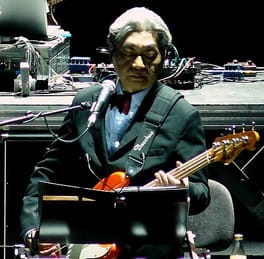
He proved you could rock in Japanese with Happy End, scattered technopop across the globe with YMO, and decades later won a Japan Academy Film Prize for a film score. Any single one of these would, for an ordinary person, be a life's work. For Haruomi Hosono, they are merely chapters.
Born in Minato, Tokyo, in 1947, Hosono has walked at the front line of Japanese music for more than half a century since his 1969 debut. And he never settles into a single style. Just as he pioneers one genre, he seems to grow bored and stroll casually off into another field—only to be found, once again, calmly running out ahead.
That very elusiveness is the heart of who Haruomi Hosono is. This is the story of a quiet revolutionary who has remade the times over and over again.
Can You Rock in Japanese? Happy End's Answer
Haruomi Hosono was born on July 9, 1947, in Minato, Tokyo. He attended Shiroganedai Elementary and Aoyama Junior High, then Rikkyo High School, and graduated from Rikkyo University's Faculty of Sociology. He immersed himself in music from his student days and made his major-label debut in 1969 as the bassist of April Fool.
Then, in 1970, he co-founded Happy End with Eiichi Ohtaki, Takashi Matsumoto, and Shigeru Suzuki. Hosono himself was at first opposed to singing rock in Japanese. Yet Happy End answered the question not with argument but with practice. They bound the Japanese language and the sound of rock together seamlessly, building the very prototype for the Japanese-language rock that followed.
Happy End disbanded in 1973, but its influence is immeasurable. By then, Hosono had already redrawn Japan's musical map once.
Solo Work and Tin Pan Alley: From Port Town to the Tropics
In 1973, the same year Happy End broke up, Hosono released his solo debut album HOSONO HOUSE. Recorded at home, it offered a warm, unforced sound world, and remains a classic beloved by musicians to this day. Around the same time he co-founded Caramel Mama (later Tin Pan Alley), throwing himself into work as a producer and bassist as well.
His solo work that followed never stayed in one place. On 1975's Tropical Dandy and 1978's Haraiso, he stepped lightly into an exotic, tropical sound world. Rather than chasing trends, he traveled through sound wherever his own curiosity led—an attitude already fully on display here.
The way he plays bass is almost as if he is letting the song itself breathe. He never pushes too far forward, yet holds the whole thing up. That exquisite sense of distance is what gives Hosono's music its ease.
YMO: Seeds of Techno Scattered Worldwide
In 1978, Hosono formed Yellow Magic Orchestra (YMO) with Yukihiro Takahashi and Ryuichi Sakamoto. This became the catalyst that made his name ring out across the world.
YMO's technopop, boldly incorporating synthesizers and computers, sparked a boom not only in Japan but globally. Works like 1979's SOLID STATE SURVIVOR were received as the sound of a new era. A pioneer of Japanese-language rock now stood at the cutting edge of electronic music.
YMO disbanded in 1983. Bound to no single place, the members gathered when needed and scattered again. That suppleness, too, was characteristically Hosono.
Film Music and a Fifty-Year Journey
Even after YMO disbanded, Hosono's exploration did not stop. He moved to Teichiku and in 1984 launched his own labels, Non Standard and Monad. In 1985 he composed the soundtrack for the anime film Night on the Galactic Railroad, showing his gift for music written for the screen.
Perhaps the culmination of this came in 2018, with the music for Hirokazu Kore-eda's film Shoplifters. For this work Hosono won Best Music at the 42nd Japan Academy Film Prize. To keep winning new acclaim nearly half a century after his debut was nothing short of astonishing. He also received the Minister of Education's Art Encouragement Prize in 2008 and the 2020 Asahi Prize in 2021.
In 2019 the 50th-anniversary documentary No Smoking was released, and he released the ambitious HOCHONO HOUSE—a project in which he dismantled and reconstructed his own starting point, HOSONO HOUSE, half a century on.
Happy End, Tin Pan Alley, YMO, solo work, and film scores. In every field, Haruomi Hosono quietly ran out ahead, and whenever he grew bored, simply walked off to another. Work that would ordinarily feed a person for a lifetime, he has done again and again.
And yet he never puts on airs. He mumbles and—smiling all the while—gets on with making his next strange and wonderful sound. He looks utterly relaxed, shoulders loose, yet the sounds that emerge are always several steps ahead. To think that this one man has redrawn Japan's musical map so many times is enough to make you simply, quietly, bow your head.