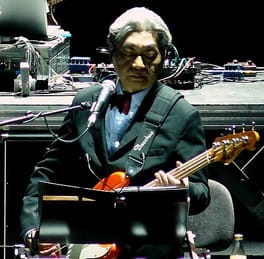
Photo: YMOHosono2008(wide).jpg: JJ Hall from Peckham Rye, London, UK derivative work: Solid State Survivor (talk) / CC BY 2.0 (source: Wikimedia Commons)
My Take
Okay, Haruomi Hosono is one of those guys where the more you dig, the more absurd it gets. He basically proved you could rock in Japanese with Happy End, then turned around and helped invent the global sound of synth-pop with YMO, and decades later he's scoring Kore-eda's Shoplifters and picking up an award for it. Who does that? What I love is he never seems to be flexing. His solo stuff drifts from that warm HOSONO HOUSE living-room vibe into this playful tropical exotica, always curious, never chasing a trend, just wandering off into whatever sound he feels like. He plays bass like he's letting the song breathe, and he's somehow always a few steps ahead while looking totally relaxed about it. Genuinely one of my favorite musical minds anywhere.
This take was written by generative AI, one per person, from publicly reported facts (editorial policy). It is a reading of the record, not reporting.
Story
The Man Who Redrew Japan's Musical Map Again and Again: Haruomi Hosono, the Quiet Revolutionary
Overview
Haruomi Hosono made his major-label debut in 1969 as the bassist of April Fool, and went on to co-found the seminal Japanese rock band Happy End with Eiichi Ohtaki, Takashi Matsumoto, and Shigeru Suzuki in 1970. In 1978 he formed Yellow Magic Orchestra (YMO) alongside Yukihiro Takahashi and Ryuichi Sakamoto, pioneering technopop on a global scale. Beyond his band work, he has had a prolific solo career as a singer-songwriter and record producer, and composed the music for Hirokazu Kore-eda's 2018 film Shoplifters, earning the Japan Academy Film Prize for Best Music.
1. Profile
- Name (English)
- Haruomi Hosono
- Name (Japanese)
- 細野晴臣
- Reading
- ほそのはるおみ
- Born
- July 9, 1947 (age 79)
- Origin
- Minato, Tokyo, Japan
- Height
- 170 cm
- Occupation
- Musician / Music Producer / Singer-Songwriter / Bassist
- Zodiac / Chinese zodiac
- Cancer / Boar
- Blood type
- A
- Agency
- Medium
- Active years
- 1969–present
2. Background
- Elementary school
- Shiroganedai Elementary School, Minato (municipal)
- Junior high
- Aoyama Junior High School, Minato (municipal)
- High school
- Rikkyo High School (now Rikkyo Niiza High School)
- University
- Rikkyo University, Faculty of Sociology (graduated 1971)
- Debut
- 1969, major-label debut as bassist of April Fool
Awards & achievements
- 2008 Agency for Cultural Affairs Minister's Award for Fine Arts (Popular Entertainment)
- 2015 42nd Kinema Junpo Readers' Award (column "Let's Listen to Movies")
- 2019 42nd Japan Academy Film Prize – Best Music (Shoplifters)
- 2021 2020 Asahi Prize
Timeline
- 1969Major-label debut as bassist of April Fool
- 1970Co-founded Happy End with Eiichi Ohtaki, Takashi Matsumoto, and Shigeru Suzuki
- 1973Happy End disbanded; released solo debut album HOSONO HOUSE; co-founded Caramel Mama
- 1978Co-founded Yellow Magic Orchestra (YMO) with Yukihiro Takahashi and Ryuichi Sakamoto
- 1983YMO disbanded; moved to Teichiku and launched the Non Standard and Monad labels
- 1985Composed the soundtrack for the anime film Night on the Galactic Railroad
- 2018Composed music for Hirokazu Kore-eda's film Shoplifters; won Japan Academy Film Prize for Best Music
- 2019The 50th-anniversary documentary film No Smoking was released
- 2021Received the 2020 Asahi Prize
3. Personality
Hobbies
- Drawing and illustration
- Listening to music
Specialties
- Bass playing
- Music production
- Composition and arrangement
4. Works & records
Works summary
- Works
- 327
- By year (titles with a known year)
- 1973: 2, 1974: 1, 1975: 3, 1976: 2, 1978: 3, 1979: 1, 1982: 3, 1983: 1, 1984: 6, 1985: 5, 1987: 2, 1988: 2, 1989: 2, 1990: 1, 1992: 2, 1993: 2, 1995: 2, 1998: 2, 2000: 3, 2001: 2, 2002: 1, 2003: 1, 2004: 1, 2005: 1, 2006: 2, 2007: 4, 2008: 4, 2009: 1, 2011: 1, 2013: 1, 2016: 1, 2017: 2, 2018: 1, 2019: 5, 2020: 3, 2021: 3, 2024: 2, 2025: 1, 2026: 1, year unknown: 244
Filmography / notable works
| Category | Title | Role | Year |
|---|---|---|---|
| Album | HOSONO HOUSE | Artist | 1973 |
| Album | Tropical Dandy | Artist | 1975 |
| Album | Haraiso | Artist | 1978 |
| Album | Yellow Magic Orchestra (YMO) | Member / Producer | 1978 |
| Album | SOLID STATE SURVIVOR (YMO) | Member | 1979 |
| Album | OMNI SIGHT SEEING | Artist | 1989 |
| Soundtrack | Night on the Galactic Railroad | Composer | 1985 |
| Film Score | Shoplifters | Composer | 2018 |
| Album | HOCHONO HOUSE | Artist | 2019 |
5. Links
6. About this entry
Tags
- Last updated
Only publicly available facts are listed; non-public or unconfirmed items are omitted. Base data was compiled from Wikidata from June 2026 onward; ages are recalculated daily and deaths are checked against Wikidata on an ongoing basis. Works and profile fields sourced from Wikipedia reflect content as of 2026-08-26. English text is machine-assisted (facts translated by Sonnet, "My Take" written by Opus 4.8). The Japanese page is the source of record.
Frequently asked questions
When was Haruomi Hosono born?
Haruomi Hosono was born on July 9, 1947 and is 79 years old.
Where is Haruomi Hosono from?
Haruomi Hosono is from Minato, Tokyo, Japan.
What does Haruomi Hosono do?
Haruomi Hosono works as Musician, Music Producer, Singer-Songwriter, Bassist.
How tall is Haruomi Hosono?
Haruomi Hosono is 170 cm tall.
What is Haruomi Hosono's blood type?
Haruomi Hosono's blood type is A.
Where did Haruomi Hosono study?
Haruomi Hosono attended Rikkyo University.
What agency is Haruomi Hosono with?
Haruomi Hosono is with Medium.
How long has Haruomi Hosono been active?
Haruomi Hosono's recorded active years are 1969–present.
What is Haruomi Hosono known for?
Haruomi Hosono's notable works include HOSONO HOUSE, Tropical Dandy, Haraiso.
Musician — see all → · Music Producer — see all → · More people from Japan → · More people born on July 9 →