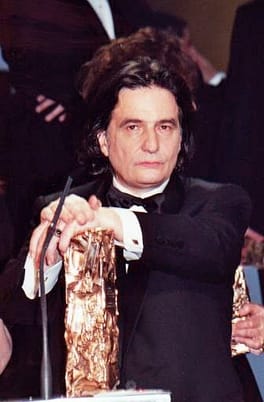
Photo: Georges Biard / CC BY-SA 3.0 (source: Wikimedia Commons)
Jean-Pierre Léaud, born on May 28, 1944 in 20th arrondissement of Paris, France, is a film director, screenwriter and film actor. Jean-Pierre Léaud is 82 years old as of 2026. Listed accolades include Knight of the Legion of Honour, Honorary César (2000), Honorary Palme d'Or (2016) and 3 more.
My Take
What fascinates me about Jean-Pierre Léaud is that he didn't just act in cinema history, he grew up inside it. From the boy running on the beach in The 400 Blows to a lifelong emblem of the French New Wave, his career feels like one continuous performance witnessed across decades. The honors pile up, an Honorary Palme d'Or, an Honorary César, but what stays with me is the nervous, unguarded quality he never lost. Even as an old man, the restless boy is still visible underneath, and I find that fragile honesty far more moving than any polished technique could ever be.
This take was written by generative AI, one per person, from publicly reported facts (editorial policy). It is a reading of the record, not reporting.
1. Profile
- Name (English)
- Jean-Pierre Léaud
- Name (Japanese)
- ジャン=ピエール・レオ
- Reading
- じゃん=ぴえーる・れお
- Born
- May 28, 1944 (age 82)
- Origin
- 20th arrondissement of Paris, France
- Occupation
- film director / screenwriter / film actor
- Zodiac / Chinese zodiac
- Gemini / Monkey
2. Background
Awards & achievements
- Knight of the Legion of Honour
- 2000 Honorary César
- 2016 Honorary Palme d'Or
- 1964 Silver Bear for Best Actor
- Commander of the Order of Merit of Portugal
- Silver Bear
3. Links
4. About this entry
Tags
- Last updated
Facts are limited to publicly available information up to 2024; non-public or unconfirmed items are omitted. English text is machine-assisted (facts translated by Sonnet, "My Take" written by Opus 4.8). The Japanese page is the source of record.
Frequently asked questions
When was Jean-Pierre Léaud born?
Jean-Pierre Léaud was born on May 28, 1944 and is 82 years old.
Where is Jean-Pierre Léaud from?
Jean-Pierre Léaud is from 20th arrondissement of Paris, France.
What does Jean-Pierre Léaud do?
Jean-Pierre Léaud works as film director, screenwriter, film actor.
Film director — see all → · Screenwriter — see all → · More people from France → · More people born on May 28 →