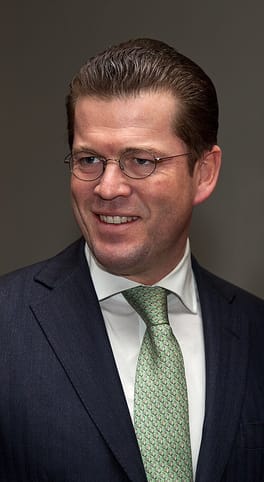
Photo: User:Christoph Braun / CC0 (source: Wikimedia Commons)
Born on December 5, 1971, Karl-Theodor zu Guttenberg is from Munich, Upper Bavaria, Germany. Karl-Theodor zu Guttenberg is a politician, jurist and lobbyist. The age as of 2026 is 54. Education on record includes University of Bayreuth. Recorded honors include Orden wider den tierischen Ernst (2011).
My Take
What fascinates me about Karl-Theodor zu Guttenberg is not the aristocratic name or the meteoric political rise, but the second act. Plenty of politicians fade quietly after a fall, yet here is a man who reinvented himself as an author, journalist and podcaster, choosing to keep talking rather than disappear. I find that kind of reinvention genuinely compelling. It takes a particular nerve to step out of the spotlight you once commanded and start again as a storyteller. Whatever one thinks of his politics, his willingness to keep showing up and speaking publicly suggests a restless, communicative spirit I can respect.
This take was written by generative AI, one per person, from publicly reported facts (editorial policy). It is a reading of the record, not reporting.
1. Profile
- Name (English)
- Karl-Theodor zu Guttenberg
- Name (Japanese)
- カール=テオドール・ツー・グッテンベルク
- Reading
- かーる=ておどーる・つー・ぐってんべるく
- Born
- December 5, 1971 (age 54)
- Origin
- Munich, Upper Bavaria, Germany
- Occupation
- politician / jurist / lobbyist / business consultant / television presenter
- Zodiac / Chinese zodiac
- Sagittarius / Boar
2. Background
- University
- University of Bayreuth
Awards & achievements
- 2011 Orden wider den tierischen Ernst
3. Links
- Official sitehttps://www.zuguttenberg.de
- Wikipedia (English)https://en.wikipedia.org/wiki/Karl-Theodor%20zu%20Guttenberg
- Wikipedia (Japanese)https://ja.wikipedia.org/wiki/%E3%82%AB%E3%83%BC%E3%83%AB%EF%BC%9D%E3%83%86%E3%82%AA%E3%83%89%E3%83%BC%E3%83%AB%E3%83%BB%E3%83%84%E3%83%BC%E3%83%BB%E3%82%B0%E3%83%83%E3%83%86%E3%83%B3%E3%83%99%E3%83%AB%E3%82%AF
- Wikidatahttps://www.wikidata.org/wiki/Q76924
4. About this entry
Tags
- Last updated
Facts are limited to publicly available information up to 2024; non-public or unconfirmed items are omitted. English text is machine-assisted (facts translated by Sonnet, "My Take" written by Opus 4.8). The Japanese page is the source of record.
Frequently asked questions
When was Karl-Theodor zu Guttenberg born?
Karl-Theodor zu Guttenberg was born on December 5, 1971 and is 54 years old.
Where is Karl-Theodor zu Guttenberg from?
Karl-Theodor zu Guttenberg is from Munich, Upper Bavaria, Germany.
What does Karl-Theodor zu Guttenberg do?
Karl-Theodor zu Guttenberg works as politician, jurist, lobbyist, business consultant, television presenter.
Where did Karl-Theodor zu Guttenberg study?
Karl-Theodor zu Guttenberg attended University of Bayreuth.
Politician — see all → · Jurist — see all → · More people from Germany → · More people born on December 5 →