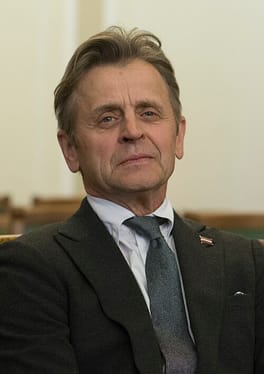
Photo: Saeima / CC BY-SA 2.0 (source: Wikimedia Commons)
Born on January 27, 1948 in Riga, Latvia, Mikhail Baryshnikov is an actor, choreographer and ballet dancer. Mikhail Baryshnikov is 78 years old as of 2026. Listed accolades include Emmy Award, Kennedy Center Honors (2000), National Medal of Arts (2000) and 5 more.
My Take
Mikhail Baryshnikov is, for me, the rare artist whose life is as dramatic as his art. Defecting from the Kirov Ballet to the West in 1974 was a leap of pure conviction, and the dancing that followed defined an era; he was simply the preeminent male classical dancer of his time. What moves me more, though, is that he never coasted on that peak. He reinvented himself as a choreographer and actor and earned honors from the Kennedy Center to Japan's Praemium Imperiale. I see him less as a prodigy than as a relentless explorer who treated mastery as a starting point.
This take was written by generative AI, one per person, from publicly reported facts (editorial policy). It is a reading of the record, not reporting.
1. Profile
- Name (English)
- Mikhail Baryshnikov
- Name (Japanese)
- ミハイル・バリシニコフ
- Reading
- みはいる・ばりしにこふ
- Born
- January 27, 1948 (age 78)
- Origin
- Riga, Latvia
- Occupation
- actor / choreographer / dancer / ballet dancer / ballet master
- Zodiac / Chinese zodiac
- Aquarius / Rat
2. Background
Awards & achievements
- Emmy Award
- 2000 Kennedy Center Honors
- 2000 National Medal of Arts
- 1989 Theatre World Special Award
- 1973 Merited Artist of the RSFSR
- 2012 Vilcek Prize
- 2017 Praemium Imperiale
- Fellow of the American Academy of Arts and Sciences
3. Links
4. About this entry
Tags
- Last updated
Facts are limited to publicly available information up to 2024; non-public or unconfirmed items are omitted. English text is machine-assisted (facts translated by Sonnet, "My Take" written by Opus 4.8). The Japanese page is the source of record.
Frequently asked questions
When was Mikhail Baryshnikov born?
Mikhail Baryshnikov was born on January 27, 1948 and is 78 years old.
Where is Mikhail Baryshnikov from?
Mikhail Baryshnikov is from Riga, Latvia.
What does Mikhail Baryshnikov do?
Mikhail Baryshnikov works as actor, choreographer, dancer, ballet dancer, ballet master.
Actor — see all → · Choreographer — see all → · More people from Latvia → · More people born on January 27 →