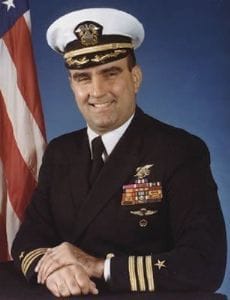
Photo: US Navy / Public domain (source: Wikimedia Commons)
Born on November 21, 1940, Richard Marcinko was from Lansford, Pennsylvania, United States. Richard Marcinko was listed as a military officer, radio personality and author. Death is recorded on December 25, 2021, at the age of 81. Schooling on record includes Auburn University. Recorded honors include Bronze Star Medal, Legionnaire of Legion of Merit and Silver Star.
My Take
Marcinko lived three lives in one. As the first commanding officer of SEAL Team Six and a decorated Vietnam veteran with the Silver and Bronze Stars, he operated at the sharpest edge of military risk. What fascinates me is the second act: he turned that lethal expertise into books, radio, and the lecture circuit, translating a world few will ever see into stories the public could grasp. Larger-than-life figures like this invite skepticism, and rightly so, but the willingness to convert hard experience into public knowledge is something I value. He went out, fittingly, as a true original.
This take was written by generative AI, one per person, from publicly reported facts (editorial policy). It is a reading of the record, not reporting.
1. Profile
- Name (English)
- Richard Marcinko
- Name (Japanese)
- リチャード・マルシンコ
- Reading
- りちゃーど・まるしんこ
- Born
- November 21, 1940 – December 25, 2021
- Origin
- Lansford, Pennsylvania, United States
- Occupation
- military officer / radio personality / author / sailor / veteran
- Zodiac / Chinese zodiac
- Scorpio / Dragon
2. Background
- University
- Auburn University
Awards & achievements
- Bronze Star Medal
- Legionnaire of Legion of Merit
- Silver Star
3. Links
- Official sitehttps://www.dickmarcinko.com/Default.aspx
- Wikipedia (English)https://en.wikipedia.org/wiki/Richard%20Marcinko
- Wikipedia (Japanese)https://ja.wikipedia.org/wiki/%E3%83%AA%E3%83%81%E3%83%A3%E3%83%BC%E3%83%89%E3%83%BB%E3%83%9E%E3%83%AB%E3%82%B7%E3%83%B3%E3%82%B3
- Wikidatahttps://www.wikidata.org/wiki/Q977522
4. About this entry
Tags
- Last updated
Facts are limited to publicly available information up to 2024; non-public or unconfirmed items are omitted. English text is machine-assisted (facts translated by Sonnet, "My Take" written by Opus 4.8). The Japanese page is the source of record.
Frequently asked questions
When was Richard Marcinko born?
Richard Marcinko was born on November 21, 1940.
When did Richard Marcinko die?
Richard Marcinko died on December 25, 2021, aged 81.
Where was Richard Marcinko from?
Richard Marcinko was from Lansford, Pennsylvania, United States.
What did Richard Marcinko do?
Richard Marcinko worked as military officer, radio personality, author, sailor, veteran.
Where did Richard Marcinko study?
Richard Marcinko attended Auburn University.
Military officer — see all → · Radio personality — see all → · More people from the United States → · More people born on November 21 →