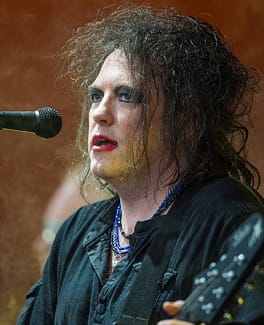
Photo: Bill Ebbesen / CC BY-SA 3.0 (source: Wikimedia Commons)
Robert Smith was born on April 21, 1959 in Blackpool, United Kingdom. Public records list Robert Smith as a singer-songwriter, guitarist and singer. The age as of 2026 is 67.
My Take
Robert Smith is one of the very few artists who built an entire emotional climate and then lived in it for fifty years. Since founding the Cure in 1976, he has been its only constant — the smeared lipstick, the wild black hair, the shimmering guitar lines — and what reads as costume on imitators reads as conviction on him. What I treasure most is the contradiction he mastered: songs that mourn and dance at the same time. Generations of outsiders found shelter in that sound. Trends have lapped him a dozen times, yet nothing he made feels dated. To me, that is the clearest definition of an artist rather than an act.
This take was written by generative AI, one per person, from publicly reported facts (editorial policy). It is a reading of the record, not reporting.
1. Profile
- Name (English)
- Robert Smith
- Name (Japanese)
- ロバート・スミス
- Reading
- ろばーと・すみす
- Born
- April 21, 1959 (age 67)
- Origin
- Blackpool, United Kingdom
- Occupation
- singer-songwriter / guitarist / singer / manufacturer / keyboardist
- Zodiac / Chinese zodiac
- Taurus / Boar
2. Links
- Wikipedia (English)https://en.wikipedia.org/wiki/Robert%20Smith%20(musician)
- Wikipedia (Japanese)https://ja.wikipedia.org/wiki/%E3%83%AD%E3%83%90%E3%83%BC%E3%83%88%E3%83%BB%E3%82%B9%E3%83%9F%E3%82%B9%20(%E3%83%9F%E3%83%A5%E3%83%BC%E3%82%B8%E3%82%B7%E3%83%A3%E3%83%B3)
- Wikidatahttps://www.wikidata.org/wiki/Q491252
3. About this entry
Tags
- Last updated
Facts are limited to publicly available information up to 2024; non-public or unconfirmed items are omitted. English text is machine-assisted (facts translated by Sonnet, "My Take" written by Opus 4.8). The Japanese page is the source of record.
Frequently asked questions
When was Robert Smith born?
Born April 21, 1959 (age 67).
Where is Robert Smith from?
Robert Smith is from Blackpool, United Kingdom.
What does Robert Smith do?
Robert Smith works as singer-songwriter, guitarist, singer, manufacturer, keyboardist.
Singer-songwriter — see all → · Guitarist — see all → · More people from the United Kingdom →