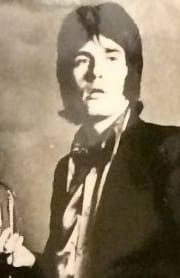
Photo: Tetragrammaton Records / Public domain (source: Wikimedia Commons)
Rod Evans is a singer and songwriter. Rod Evans was born in Slough, United Kingdom on January 19, 1947. The age as of 2026 is 79. Recorded honors include Rock and Roll Hall of Fame.
My Take
Rod Evans is one of rock history's great what-ifs — the guy who sang on Deep Purple's first three albums, including the swooning, orchestral "Hush," and then simply vanished from the music world after a bizarre early-'80s impersonation scandal that ended with lawsuits and silence. I find him fascinating precisely because his voice was so different from what Deep Purple became: smooth, soulful, almost pop-friendly, a million miles from Gillan's screaming. He then briefly fronted Captain Beyond, whose self-titled 1972 debut is genuinely underrated psychedelic gold. That he's a Rock and Roll Hall of Fame inductee as part of Deep Purple yet has been publicly invisible for decades makes him one of the most enigmatic figures in classic rock — a founding piece of a legendary band who quietly stepped offstage and never came back.
This take was written by generative AI, one per person, from publicly reported facts (editorial policy). It is a reading of the record, not reporting.
1. Profile
- Name (English)
- Rod Evans
- Name (Japanese)
- ロッド・エヴァンス
- Reading
- ろっど・えゔぁんす
- Born
- January 19, 1947 (age 79)
- Origin
- Slough, United Kingdom
- Occupation
- singer / songwriter
- Zodiac / Chinese zodiac
- Capricorn / Boar
2. Background
Awards & achievements
- Rock and Roll Hall of Fame
3. Links
4. About this entry
Tags
- Last updated
Only publicly available facts are listed; non-public or unconfirmed items are omitted. Base data was compiled from Wikidata from June 2026 onward; ages are recalculated daily and deaths are checked against Wikidata on an ongoing basis. English text is machine-assisted (facts translated by Sonnet, "My Take" written by Opus 4.8). The Japanese page is the source of record.
Frequently asked questions
When was Rod Evans born?
Rod Evans was born on January 19, 1947 and is 79 years old.
Where is Rod Evans from?
Rod Evans is from Slough, United Kingdom.
What does Rod Evans do?
Rod Evans works as singer, songwriter.
Singer — see all → · Songwriter — see all → · More people from the United Kingdom → · More people born on January 19 →