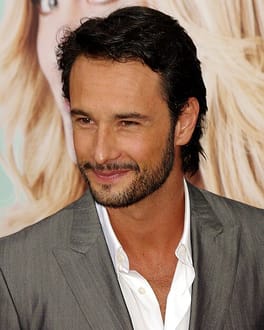
Photo: David Shankbone / CC BY 3.0 (source: Wikimedia Commons)
Rodrigo Santoro is a film actor, television actor and film producer, born on August 22, 1975 in Petrópolis, Rio de Janeiro, Brazil. That puts Rodrigo Santoro at 51 years old in 2026. Education on record includes Pontifical Catholic University of Rio de Janeiro. Recorded honors include Cinema Brazil Grand Prize for Best Actor and Trophée Chopard.
My Take
Rodrigo Santoro is a chameleon I never tire of watching. In Brazil he is beloved telenovela royalty; in Hollywood he buried himself under gold paint and prosthetics to become Xerxes in 300, a performance so transformed that many viewers never realized the god-king was a Brazilian heartthrob. That willingness to disappear into a role, even at the cost of his own handsome face, tells me he is an actor first and a star second. He has also quietly become a bridge between Latin American and global cinema, producing as well as performing. Few actors move between languages, industries, and genres this gracefully, and I respect that ambition.
This take was written by generative AI, one per person, from publicly reported facts (editorial policy). It is a reading of the record, not reporting.
1. Profile
- Name (English)
- Rodrigo Santoro
- Name (Japanese)
- ロドリゴ・サントロ
- Reading
- ろどりご・さんとろ
- Born
- August 22, 1975 (age 51)
- Origin
- Petrópolis, Rio de Janeiro, Brazil
- Occupation
- actor / film actor / television actor / film producer
- Zodiac / Chinese zodiac
- Leo / Rabbit
2. Background
- University
- Pontifical Catholic University of Rio de Janeiro
Awards & achievements
- Cinema Brazil Grand Prize for Best Actor
- Trophée Chopard
3. Links
- Instagramhttps://www.instagram.com/rodrigosantoro/
- Xhttps://x.com/rodrigosantoro
- Wikipedia (English)https://en.wikipedia.org/wiki/Rodrigo%20Santoro
- Wikipedia (Japanese)https://ja.wikipedia.org/wiki/%E3%83%AD%E3%83%89%E3%83%AA%E3%82%B4%E3%83%BB%E3%82%B5%E3%83%B3%E3%83%88%E3%83%AD
- Wikidatahttps://www.wikidata.org/wiki/Q294819
4. About this entry
Tags
- Last updated
Facts are limited to publicly available information up to 2024; non-public or unconfirmed items are omitted. English text is machine-assisted (facts translated by Sonnet, "My Take" written by Opus 4.8). The Japanese page is the source of record.
Frequently asked questions
When was Rodrigo Santoro born?
Born August 22, 1975 (age 51).
Where is Rodrigo Santoro from?
Rodrigo Santoro is from Petrópolis, Rio de Janeiro, Brazil.
What does Rodrigo Santoro do?
Rodrigo Santoro works as actor, film actor, television actor, film producer.
Actor — see all → · Film actor — see all → · More people from Brazil →