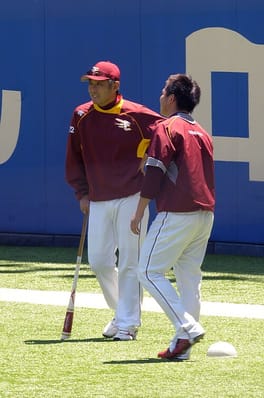
Photo: STB-1 / CC BY-SA 4.0 (source: Wikimedia Commons)
My Take
Honestly, there's something quietly compelling about a guy from Kitakyushu — that city's got a blue-collar toughness to it that you can't fake, and when I hear that Moriyama Ryoji stood 183cm on a baseball diamond, I just picture this solid, no-nonsense presence who earned every inch of his spot through sheer grind. Born in '63, which puts him right in that era of Japanese baseball where mental grit was basically the whole curriculum, and leaving the local city university to go pro as a first-round pick reads as exactly the kind of grounded, unflashy backstory that ages well. He's not someone who floats around in highlight reels, and I actually respect that — the careers that built themselves quietly, without a PR machine, tend to be the ones with real backbone underneath.
This take was written by generative AI, one per person, from publicly reported facts (editorial policy). It is a reading of the record, not reporting.
Overview
Ryoji Moriyama is a Japanese former professional baseball pitcher and coach born on July 20, 1963, in Kitakyushu, Fukuoka Prefecture. He stands 183 cm tall and attended the University of Kitakyushu without graduating. A first-round draft pick in 1986, he pitched for the Seibu Lions (1987–1992) and the Yokohama BayStars (1993–1995), then coached for teams including Seibu and Rakuten, and is now the second-team manager of the Samsung Lions.
1. Profile
- Name (English)
- Ryoji Moriyama
- Name (Japanese)
- 森山良二
- Reading
- もりやま りょうじ
- Born
- July 20, 1963 (age 63)
- Origin
- Kitakyushu, Fukuoka Prefecture, Japan
- Height
- 183cm
- Occupation
- Baseball player
- Zodiac / Chinese zodiac
- Cancer / Rabbit
2. Background
- University
- University of Kitakyushu
3. Links
- Wikipedia (Japanese)https://ja.wikipedia.org/wiki/%E6%A3%AE%E5%B1%B1%E8%89%AF%E4%BA%8C
- Wikidatahttps://www.wikidata.org/wiki/Q11117075
4. About this entry
Tags
- Last updated
Only publicly available facts are listed; non-public or unconfirmed items are omitted. Base data was compiled from Wikidata from June 2026 onward; ages are recalculated daily and deaths are checked against Wikidata on an ongoing basis. English text is machine-assisted (facts translated by Sonnet, "My Take" written by Opus 4.8). The Japanese page is the source of record.
Frequently asked questions
When was Ryoji Moriyama born?
Ryoji Moriyama was born on July 20, 1963 and is 63 years old.
Where is Ryoji Moriyama from?
Ryoji Moriyama is from Kitakyushu, Fukuoka Prefecture, Japan.
What does Ryoji Moriyama do?
Ryoji Moriyama works as Baseball player.
How tall is Ryoji Moriyama?
Ryoji Moriyama is 183 cm tall.
Where did Ryoji Moriyama study?
Ryoji Moriyama attended University of Kitakyushu.
Baseball player — see all → · More people from Japan → · More people born on July 20 →