The Most Powerful Primate: Saori Yoshida's 16 Titles, 206 Wins, and the Tears at the End
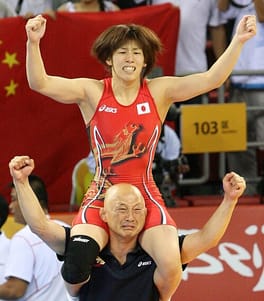
"The most powerful woman in the primate order." It is a nickname that seems to place her slightly outside the human category — and she proved it, not with exaggeration, but with records.
Sixteen consecutive World Championship titles. A streak of 206 individual victories. A Guinness World Record for thirteen straight years atop the world. For an opponent, simply finding the name "Saori Yoshida" on the bracket meant being half-defeated already.
Yet even an absolute champion meets an ending. And the tears she shed in defeat, for the very first time, moved an entire nation. This is the story of Saori Yoshida, Mie's gift to the world.
A Life Devoted to Wrestling, Beginning at Age Three
Born on October 5, 1982, in Tsu, Mie Prefecture, Saori Yoshida was bound to wrestling from birth. Her father, Eikachi Yoshida, was a former wrestler, and her mother, Yukiyo, had competed in tennis at the national games — a thoroughly athletic family.
She began wrestling at just three years old. Under her father's coaching, day after day she honed her tackle. The sharp takedown that would later become her trademark, capable of collapsing an opponent in an instant, was born from those early years of accumulation.
In 1999 she won the World Cadet Championships, and in 2000 the World Junior Championships, steadily rising. Then in 2002 she made a sensational debut, winning the World Championships on her first appearance. Studying at Chukyo Women's University, she climbed toward the summit of the sport.
Athens, Beijing, London — Queen of the Three-Peat
At the 2004 Athens Olympics, the first to include women's wrestling as an official event, Yoshida won gold in the women's 55 kg freestyle category. That same year she received the Medal of Honor with Purple Ribbon.
The glory did not end there. At Beijing 2008 and London 2012, she claimed gold at three consecutive Olympic Games. She received the Purple Ribbon medal three times in all. And in 2012, in recognition of her overwhelming achievements, she was awarded Japan's People's Honor Award.
That same year, Guinness World Records officially certified her thirteen consecutive years as world champion. By 2014 she had reached uncharted figures: sixteen straight world titles and 206 consecutive individual victories. Winning had become, for her, simply ordinary.
The Tears in Rio — The Human Face of an Invincible Queen
But at the 2016 Rio de Janeiro Olympics, in the final that carried her streak, Yoshida was at last defeated. She took home a silver medal.
Her tearful press conference afterward left a deep impression across Japan. A woman who had been so strong, who had won for so long, weeping openly without restraint — the sight brought many to tears alongside her. Only in defeat did people realize that she, too, was a single human being who had carried more pressure than anyone in pursuit of victory.
People came to love both her strength and her vulnerability. The tears of a queen who had been too perfect made her all the more human, and all the more beloved.
Her Father's Teaching, and Retirement — The Close of 33 Years
At the foundation of Yoshida's career stood her father, Eikachi Yoshida. He had coached her from age three, and under head coach Kazuhito Sakae she sharpened her technique further. But her father passed away in 2014. The death of the coach who had raised the strongest of daughters must have been an immeasurable loss.
In 2016, leaving ALSOK, the company she had long belonged to, she became independent, and in January 2019 she finally announced her retirement. It was the moment the curtain fell on a wrestling career that had begun at age three and spanned 33 years.
After retiring, she set out on new paths as a sports coach and a television personality. The endearing smile she shows on screen, almost unbelievable for the strongest woman alive — that contrast charmed people all over again.
She loves ramen and yakitori, and her eyes light up at Disney — in daily life she is an approachable, ordinary woman. But the moment she steps onto the mat, she becomes the strongest woman on Earth. That very contrast was the charm of Saori Yoshida.
"I love wrestling." Her own words say it all. A woman who climbed from rural Mie to the summit of the world taught us, through both victory and defeat, what true strength means.