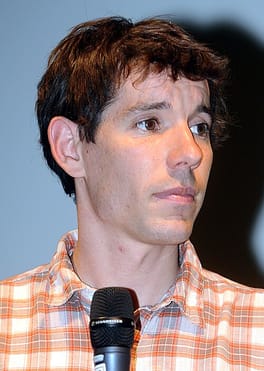
Photo: Niccolò Caranti / CC BY-SA 3.0 (source: Wikimedia Commons)
Alex Honnold, born on August 17, 1985 in Sacramento, California, United States, is a rock climber, author and mountaineer. As of 2026, Alex Honnold is 41 years old. Schooling on record includes Mira Loma High School and University of California, Berkeley.
My Take
I find Alex Honnold endlessly fascinating because his free solo of El Capitan was the opposite of recklessness. Behind that 2017 climb were years of rehearsal, memorized sequences, and a mind that treats fear as an engineering problem. That discipline impresses me more than the athletic feat itself. He is also that rare athlete who can articulate what he does, through books, podcasts, and an almost unsettling honesty about risk and mortality. Watching him made me reconsider what preparation really means. Most of us hedge everything; Honnold removed the hedge entirely and survived on pure competence. I cannot look away from that.
This take was written by generative AI, one per person, from publicly reported facts (editorial policy). It is a reading of the record, not reporting.
1. Profile
- Name (English)
- Alex Honnold
- Name (Japanese)
- アレックス・オノルド
- Reading
- あれっくす・おのるど
- Born
- August 17, 1985 (age 41)
- Origin
- Sacramento, California, United States
- Occupation
- rock climber / author / mountaineer / podcaster
- Zodiac / Chinese zodiac
- Leo / Ox
2. Background
- High school
- Mira Loma High School
- University
- University of California, Berkeley
3. Links
- Official sitehttps://www.alexhonnold.com
- Instagramhttps://www.instagram.com/alexhonnold/
- Xhttps://x.com/AlexHonnold
- Wikipedia (English)https://en.wikipedia.org/wiki/Alex%20Honnold
- Wikipedia (Japanese)https://ja.wikipedia.org/wiki/%E3%82%A2%E3%83%AC%E3%83%83%E3%82%AF%E3%82%B9%E3%83%BB%E3%82%AA%E3%83%8E%E3%83%AB%E3%83%89
- Wikidatahttps://www.wikidata.org/wiki/Q979249
4. About this entry
Tags
- Last updated
Facts are limited to publicly available information up to 2024; non-public or unconfirmed items are omitted. English text is machine-assisted (facts translated by Sonnet, "My Take" written by Opus 4.8). The Japanese page is the source of record.
Frequently asked questions
When was Alex Honnold born?
Born August 17, 1985 (age 41).
Where is Alex Honnold from?
Alex Honnold is from Sacramento, California, United States.
What does Alex Honnold do?
Alex Honnold works as rock climber, author, mountaineer, podcaster.