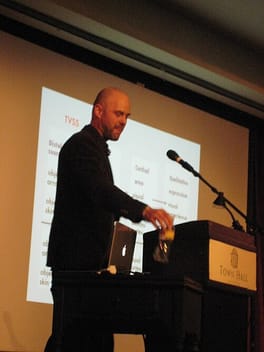
Photo: jwalsh from Seattle / CC BY 2.0 (source: Wikimedia Commons)
Public records list Alva Noë as a philosopher and university teacher. Alva Noë was educated at University of Oxford. Listed accolades include Guggenheim Fellowship.
My Take
Alva Noë is the rare philosopher I would actually want to argue with over coffee. An American educated at Oxford and now a professor at UC Berkeley, he works on perception and consciousness, pushing the enactivist idea that the mind is not trapped inside the skull but enacted through the whole body's engagement with the world. I admire how widely he ranges, from cognitive science to Wittgenstein to the theory of art, and that a Guggenheim Fellow chooses to wrestle with something as everyday as what it means to see. He brings hard questions back down to lived experience, and that gift earns my respect.
This take was written by generative AI, one per person, from publicly reported facts (editorial policy). It is a reading of the record, not reporting.
1. Profile
- Name (English)
- Alva Noë
- Name (Japanese)
- アルヴァ・ノエ
- Reading
- あるゔぁ・のえ
- Born
- 1964
- Occupation
- philosopher / university teacher
- Zodiac / Chinese zodiac
- Dragon
2. Background
- University
- University of Oxford
Awards & achievements
- Guggenheim Fellowship
3. Links
- Wikipedia (English)https://en.wikipedia.org/wiki/Alva%20No%C3%AB
- Wikipedia (Japanese)https://ja.wikipedia.org/wiki/%E3%82%A2%E3%83%AB%E3%83%B4%E3%82%A1%E3%83%BB%E3%83%8E%E3%82%A8
- Wikidatahttps://www.wikidata.org/wiki/Q258358
4. About this entry
Tags
- Last updated
Facts are limited to publicly available information up to 2024; non-public or unconfirmed items are omitted. English text is machine-assisted (facts translated by Sonnet, "My Take" written by Opus 4.8). The Japanese page is the source of record.