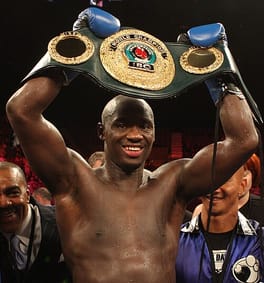
Photo: Eva Rinaldi / CC BY-SA 2.0 (source: Wikimedia Commons)
My Take
Tarver will always be the man who finally toppled Roy Jones Jr., and that second-round knockout in 2004 is one of those moments that rewired the light heavyweight division. I loved his pre-fight bravado, especially the legendary 'Do you have any excuses tonight, Roy?' line that became folklore. Beyond the ring, his turn as Mason Dixon in Rocky Balboa was a smart bit of crossover casting that actually worked because he could really fight. His later years got tangled in a doping suspension, which dents the legacy, but at his peak Tarver was a sharp southpaw with genuine star charisma.
This take was written by generative AI, one per person, from publicly reported facts (editorial policy). It is a reading of the record, not reporting.
Overview
Antonio Tarver (born November 21, 1968) is an American former professional boxer and actor. A light heavyweight world champion, he is best known for his rivalry with Roy Jones Jr., whom he knocked out in 2004. He also appeared as the boxer Mason 'The Line' Dixon in the 2006 film Rocky Balboa.
1. Profile
- Name (English)
- Antonio Tarver
- Name (Japanese)
- アントニオ・ターバー
- Reading
- あんとにお・たーばー
- Born
- November 21, 1968 (age 57)
- Origin
- Orlando, Florida, United States
- Height
- 188cm
- Occupation
- Boxer / Actor
- Zodiac / Chinese zodiac
- Scorpio / Monkey
2. Background
- High school
- William R. Boone High School
3. Links
4. About this entry
Tags
- Last updated
Facts are limited to publicly available information up to 2024; non-public or unconfirmed items are omitted. English text is machine-assisted (facts translated by Sonnet, "My Take" written by Opus 4.8). The Japanese page is the source of record.
Frequently asked questions
When was Antonio Tarver born?
Antonio Tarver was born on November 21, 1968 and is 57 years old.
Where is Antonio Tarver from?
Antonio Tarver is from Orlando, Florida, United States.
What does Antonio Tarver do?
Antonio Tarver works as Boxer, Actor.
How tall is Antonio Tarver?
Antonio Tarver is 188 cm tall.
Which high school did Antonio Tarver attend?
Antonio Tarver attended William R. Boone High School.
Boxer — see all → · Actor — see all → · More people from the United States → · More people born on November 21 →