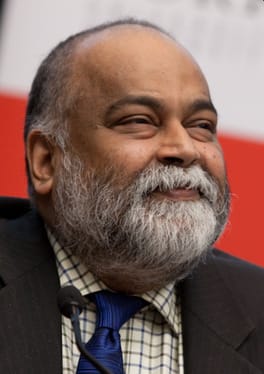
Photo: TheSilentPhotographer (talk) / CC BY 3.0 (source: Wikimedia Commons)
Arjun Appadurai, born on February 4, 1949 in Mumbai, Bombay State, India, is an anthropologist, sociologist and academic. As of 2026, Arjun Appadurai is 77 years old. Education on record includes University of Chicago. Recorded honors include Fellow of the American Academy of Arts and Sciences.
My Take
Among the people I cover, Appadurai stands apart as a genuine intellectual heavyweight. A Mumbai-born, Chicago-trained anthropologist who became one of the defining theorists of globalization, he gave us a vocabulary for how people, goods and especially imagination flow across borders. What astonishes me is the foresight: decades before our hyper-connected social-media age, he was already mapping how imagination becomes a collective social practice. The Fellowship of the American Academy of Arts and Sciences is well earned. I find more romance in a thinker who quietly reshaped how we see the world than in most celebrities, and he is squarely that.
This take was written by generative AI, one per person, from publicly reported facts (editorial policy). It is a reading of the record, not reporting.
1. Profile
- Name (English)
- Arjun Appadurai
- Name (Japanese)
- アルジュン・アパデュライ
- Reading
- あるじゅん・あぱでゅらい
- Born
- February 4, 1949 (age 77)
- Origin
- Mumbai, Bombay State, India
- Occupation
- anthropologist / sociologist / academic / theorist / ethnologist
- Zodiac / Chinese zodiac
- Aquarius / Ox
2. Background
- University
- University of Chicago
Awards & achievements
- Fellow of the American Academy of Arts and Sciences
3. Links
- Official sitehttp://www.appadurai.org
- Wikipedia (English)https://en.wikipedia.org/wiki/Arjun%20Appadurai
- Wikipedia (Japanese)https://ja.wikipedia.org/wiki/%E3%82%A2%E3%83%AB%E3%82%B8%E3%83%A5%E3%83%B3%E3%83%BB%E3%82%A2%E3%83%91%E3%83%87%E3%83%A5%E3%83%A9%E3%82%A4
- Wikidatahttps://www.wikidata.org/wiki/Q560986
4. About this entry
Tags
- Last updated
Facts are limited to publicly available information up to 2024; non-public or unconfirmed items are omitted. English text is machine-assisted (facts translated by Sonnet, "My Take" written by Opus 4.8). The Japanese page is the source of record.
Frequently asked questions
When was Arjun Appadurai born?
Born February 4, 1949 (age 77).
Where is Arjun Appadurai from?
Arjun Appadurai is from Mumbai, Bombay State, India.
What does Arjun Appadurai do?
Arjun Appadurai works as anthropologist, sociologist, academic, theorist, ethnologist.
Anthropologist — see all → · Sociologist — see all → · More people from India →