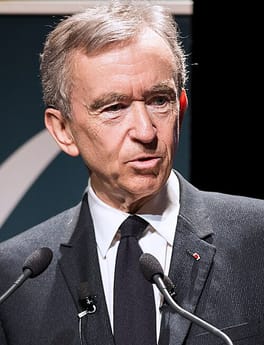
Photo: Jérémy Barande / CC BY-SA 2.0 (source: Wikimedia Commons)
Bernard Arnault, born on March 5, 1949 in Roubaix, France, is an art collector, businessperson and engineer. As of 2026, Bernard Arnault is 77 years old. Listed accolades include Commandeur des Arts et des Lettres (2002), Grand Officer of the Order of Merit of the Italian Republic (2006), Pushkin Medal (2017) and 2 more.
My Take
Say what you want about billionaires, but Bernard Arnault is genuinely fascinating — a man who turned an ailing textile conglomerate into the most powerful luxury empire on earth, owning everything from Louis Vuitton and Dior to Moët & Chandon and Bulgari under one roof at LVMH. What strikes me is that he isn't some inherited-wealth figurehead; he engineered this himself, buying into a distressed holding company in the 1980s and systematically assembling a portfolio that redefined what luxury even means at scale. He's also a serious art collector and has built the stunning Fondation Louis Vuitton museum in Paris, which shows he actually cares about culture, not just profit margins. You can debate whether consolidating so many storied fashion houses under one corporation is good for creativity, but you can't deny his ambition is operatic in scope.
This take was written by generative AI, one per person, from publicly reported facts (editorial policy). It is a reading of the record, not reporting.
1. Profile
- Name (English)
- Bernard Arnault
- Name (Japanese)
- ベルナール・アルノー
- Reading
- べるなーる・あるのー
- Born
- March 5, 1949 (age 77)
- Origin
- Roubaix, France
- Occupation
- art collector / businessperson / engineer / entrepreneur
- Zodiac / Chinese zodiac
- Pisces / Ox
2. Background
Awards & achievements
- 2002 Commandeur des Arts et des Lettres
- 2006 Grand Officer of the Order of Merit of the Italian Republic
- 2017 Pushkin Medal
- 2012 Knight Commander of the Order of the British Empire
- 2023 Grand Cross of the Legion of Honour
3. Links
- Official sitehttps://www.lvmh.com/comfi/pg_strategie.asp?rub=1
- Wikipedia (English)https://en.wikipedia.org/wiki/Bernard%20Arnault
- Wikipedia (Japanese)https://ja.wikipedia.org/wiki/%E3%83%99%E3%83%AB%E3%83%8A%E3%83%BC%E3%83%AB%E3%83%BB%E3%82%A2%E3%83%AB%E3%83%8E%E3%83%BC
- Wikidatahttps://www.wikidata.org/wiki/Q32055
4. About this entry
Tags
- Last updated
Only publicly available facts are listed; non-public or unconfirmed items are omitted. Base data was compiled from Wikidata from June 2026 onward; ages are recalculated daily and deaths are checked against Wikidata on an ongoing basis. English text is machine-assisted (facts translated by Sonnet, "My Take" written by Opus 4.8). The Japanese page is the source of record.
Frequently asked questions
When was Bernard Arnault born?
Bernard Arnault was born on March 5, 1949 and is 77 years old.
Where is Bernard Arnault from?
Bernard Arnault is from Roubaix, France.
What does Bernard Arnault do?
Bernard Arnault works as art collector, businessperson, engineer, entrepreneur.
Art collector — see all → · Businessperson — see all → · More people from France → · More people born on March 5 →