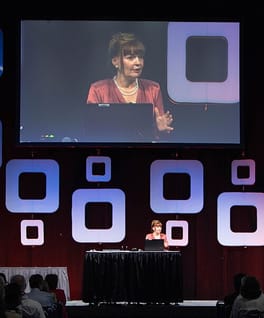
Photo: IsilSenol / CC BY-SA 4.0 (source: Wikimedia Commons)
Carol V. Robinson, born on April 10, 1956 in Kent, United Kingdom, is a chemist. As of 2026, Carol V. Robinson is 70 years old. Schooling on record includes Swansea University. Listed accolades include Fellow of the Royal Society (2004), Rosalind Franklin Award (2004), Dame Commander of the Order of the British Empire and 5 more.
My Take
Carol V. Robinson is a scientist I genuinely look up to. Born in Kent in 1956, she rose from Swansea University to become a Fellow of the Royal Society, a Davy Medal winner, a L'Oréal-UNESCO laureate, and president of the Royal Society of Chemistry, eventually made a Dame. A pioneer of mass spectrometry for studying proteins, she advanced a field while breaking ground for women in science during a far less welcoming era. What moves me is that such towering recognition rests on the patient, hands-on grind of experimentation. Making the invisible molecular world visible is quietly heroic, and she's a beacon for the researchers who follow.
This take was written by generative AI, one per person, from publicly reported facts (editorial policy). It is a reading of the record, not reporting.
1. Profile
- Name (English)
- Carol V. Robinson
- Name (Japanese)
- キャロル・V・ロビンソン
- Reading
- きゃろる・V・ろびんそん
- Born
- April 10, 1956 (age 70)
- Origin
- Kent, United Kingdom
- Occupation
- chemist
- Zodiac / Chinese zodiac
- Aries / Monkey
2. Background
- University
- Swansea University
Awards & achievements
- 2004 Fellow of the Royal Society
- 2004 Rosalind Franklin Award
- Dame Commander of the Order of the British Empire
- 2015 L'Oréal-UNESCO Award For Women in Science
- 2011 Aston Medal
- 2010 Davy Medal
- 2010 Prelog Medal and Lecture
- 2011 Interdisciplinary Prize
3. Links
- Official sitehttp://research.chem.ox.ac.uk/carol-robinson.aspx
- Wikipedia (English)https://en.wikipedia.org/wiki/Carol%20Robinson
- Wikipedia (Japanese)https://ja.wikipedia.org/wiki/%E3%82%AD%E3%83%A3%E3%83%AD%E3%83%AB%E3%83%BB%E3%83%AD%E3%83%93%E3%83%B3%E3%82%BD%E3%83%B3
- Wikidatahttps://www.wikidata.org/wiki/Q56190
4. About this entry
Tags
- Last updated
Facts are limited to publicly available information up to 2024; non-public or unconfirmed items are omitted. English text is machine-assisted (facts translated by Sonnet, "My Take" written by Opus 4.8). The Japanese page is the source of record.
Frequently asked questions
When was Carol V. Robinson born?
Born April 10, 1956 (age 70).
Where is Carol V. Robinson from?
Carol V. Robinson is from Kent, United Kingdom.
What does Carol V. Robinson do?
Carol V. Robinson works as chemist.