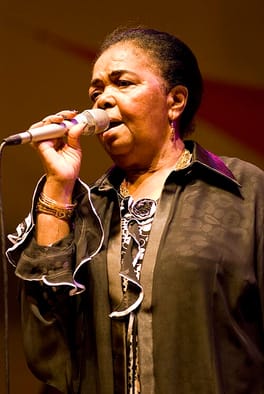
Photo: As fotos da Virada! / CC BY-SA 2.0 (source: Wikimedia Commons)
Cesária Évora was credited as a singer. Cesária Évora was born in Mindelo, Cape Verde on August 27, 1941. Death is recorded on December 17, 2011, at the age of 70. Awards on record include Knight of the Legion of Honour (2009), Grammy Award for Best Contemporary World Music Album (2003), Kora Awards (1997) and 2 more.
My Take
Cesária Évora is one of those artists who proves authenticity outsings technique. The barefoot diva from Mindelo brought morna, the soulful music of tiny Cape Verde, to the entire world, singing of homesickness and love in Creole. What moves me is that she carried global honors, a Grammy and the Legion of Honour, without ever shedding her plainspoken dignity. Her voice does not perform emotion; it simply contains a whole life. She passed in 2011, but she remains, for me, the rare singer you reach for alone late at night, when you want a sound that understands longing.
This take was written by generative AI, one per person, from publicly reported facts (editorial policy). It is a reading of the record, not reporting.
1. Profile
- Name (English)
- Cesária Évora
- Name (Japanese)
- セザリア・エヴォラ
- Reading
- せざりあ・えゔぉら
- Born
- August 27, 1941 – December 17, 2011
- Origin
- Mindelo, Cape Verde
- Occupation
- singer
- Zodiac / Chinese zodiac
- Virgo / Snake
2. Background
Awards & achievements
- 2009 Knight of the Legion of Honour
- 2003 Grammy Award for Best Contemporary World Music Album
- 1997 Kora Awards
- 2010 Order of Cultural Merit (Brazil)
- 2000 Victory of the album of traditional musics or musics of the world
- 2004 Victory of the album of traditional musics or musics of the world
3. Links
- Official sitehttps://www.cesaria-evora.com/
- Wikipedia (English)https://en.wikipedia.org/wiki/Ces%C3%A1ria%20%C3%89vora
- Wikipedia (Japanese)https://ja.wikipedia.org/wiki/%E3%82%BB%E3%82%B6%E3%83%AA%E3%82%A2%E3%83%BB%E3%82%A8%E3%83%B4%E3%82%A9%E3%83%A9
- Wikidatahttps://www.wikidata.org/wiki/Q103759
4. About this entry
Tags
- Last updated
Facts are limited to publicly available information up to 2024; non-public or unconfirmed items are omitted. English text is machine-assisted (facts translated by Sonnet, "My Take" written by Opus 4.8). The Japanese page is the source of record.
Frequently asked questions
When was Cesária Évora born?
Cesária Évora was born on August 27, 1941.
When did Cesária Évora die?
Cesária Évora died on December 17, 2011, aged 70.
Where was Cesária Évora from?
Cesária Évora was from Mindelo, Cape Verde.
What did Cesária Évora do?
Cesária Évora worked as singer.