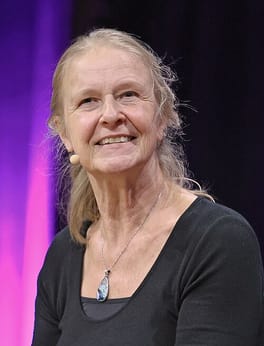
Photo: Elena Ternovaja / CC BY-SA 3.0 (source: Wikimedia Commons)
Born on December 10, 1958 in Dorsten, North Rhine-Westphalia, Germany, Cornelia Funke is a children's writer, screenwriter and illustrator. Cornelia Funke is 67 years old as of 2026. Recorded honors include Cross of the Order of Merit of the Federal Republic of Germany (2008), Roswitha Prize (2008), Annette von Droste-Hülshoff Prize (2015) and 3 more. Notable works include Inkheart.
My Take
I have a real soft spot for Cornelia Funke. The detail that she started as a social worker before drawing book illustrations and then writing tells you everything about her fiction. Her stories keep returning to children facing adversity, and I suspect that empathy was forged on the job, not at a writing desk. There is something admirable about an author who can collect a national Order of Merit yet stay devoted to children's fantasy rather than chasing literary prestige. Inkheart aside, what I value most is her stubborn belief that imagination is a survival tool for kids. That conviction reads as earned, not decorative.
This take was written by generative AI, one per person, from publicly reported facts (editorial policy). It is a reading of the record, not reporting.
1. Profile
- Name (English)
- Cornelia Funke
- Name (Japanese)
- コルネーリア・フンケ
- Reading
- こるねーりあ・ふんけ
- Born
- December 10, 1958 (age 67)
- Origin
- Dorsten, North Rhine-Westphalia, Germany
- Occupation
- writer / children's writer / screenwriter / illustrator / film producer
- Zodiac / Chinese zodiac
- Sagittarius / Dog
2. Background
Awards & achievements
- 2008 Cross of the Order of Merit of the Federal Republic of Germany
- 2008 Roswitha Prize
- 2015 Annette von Droste-Hülshoff Prize
- 2004 Zilveren Griffel
- 2000 Wildweibchenpreis
- 2004 Phantastik-Preis der Stadt Wetzlar
3. Works & records
Filmography / notable works
| Category | Title |
|---|---|
| Notable work | Inkheart |
4. Links
- Official sitehttps://corneliafunke.com
- Wikipedia (English)https://en.wikipedia.org/wiki/Cornelia%20Funke
- Wikipedia (Japanese)https://ja.wikipedia.org/wiki/%E3%82%B3%E3%83%AB%E3%83%8D%E3%83%BC%E3%83%AA%E3%82%A2%E3%83%BB%E3%83%95%E3%83%B3%E3%82%B1
- Wikidatahttps://www.wikidata.org/wiki/Q57971
5. About this entry
Tags
- Last updated
Facts are limited to publicly available information up to 2024; non-public or unconfirmed items are omitted. English text is machine-assisted (facts translated by Sonnet, "My Take" written by Opus 4.8). The Japanese page is the source of record.
Frequently asked questions
When was Cornelia Funke born?
Born December 10, 1958 (age 67).
Where is Cornelia Funke from?
Cornelia Funke is from Dorsten, North Rhine-Westphalia, Germany.
What does Cornelia Funke do?
Cornelia Funke works as writer, children's writer, screenwriter, illustrator, film producer.
What is Cornelia Funke known for?
Notable works include Inkheart.
Writer — see all → · Children's writer — see all → · More people from Germany →