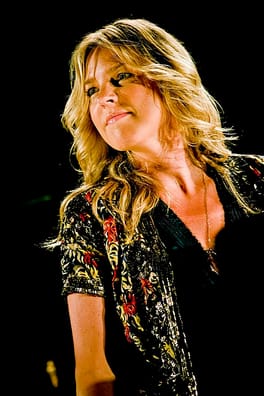
Photo: José Goulão from Lisbon, Portugal / CC BY-SA 2.0 (source: Wikimedia Commons)
Born on November 16, 1964 in Nanaimo, British Columbia, Canada, Diana Krall is a jazz singer, jazz pianist and songwriter. That puts Diana Krall at 61 years old in 2026. Schooling on record includes Berklee College of Music. Awards on record include Officer of the Order of Canada (2005), Canada's Walk of Fame (2004) and Order of British Columbia (2000).
My Take
Diana Krall is one of those rare artists who makes you feel like jazz never went anywhere — like it's been waiting in a candlelit room for you the whole time. Growing up in Nanaimo, British Columbia, she somehow absorbed the Great American Songbook deeper than most Americans ever do, then headed to Berklee and came out the other side with a touch that's equal parts Oscar Peterson swing and Nat King Cole intimacy. What gets me is that smoky contralto layered over her own piano playing — she's not just a singer who sits at a keyboard, she's a genuine pianist-vocalist where neither half feels like an afterthought. Selling over 15 million albums worldwide while Billboard called her the second-greatest jazz artist of the 2000s decade is validation that the mainstream actually got one right for a change. Canada's Walk of Fame, the Order of Canada — she's earned every bit of it.
This take was written by generative AI, one per person, from publicly reported facts (editorial policy). It is a reading of the record, not reporting.
1. Profile
- Name (English)
- Diana Krall
- Name (Japanese)
- ダイアナ・クラール
- Reading
- だいあな・くらーる
- Born
- November 16, 1964 (age 61)
- Origin
- Nanaimo, British Columbia, Canada
- Occupation
- jazz singer / jazz pianist / songwriter / singer / pianist
- Zodiac / Chinese zodiac
- Scorpio / Dragon
2. Background
- University
- Berklee College of Music
Awards & achievements
- 2005 Officer of the Order of Canada
- 2004 Canada's Walk of Fame
- 2000 Order of British Columbia
3. Links
- Official sitehttps://www.dianakrall.com
- Instagramhttps://www.instagram.com/dianakrall/
- Xhttps://x.com/DianaKrall
- Wikipedia (English)https://en.wikipedia.org/wiki/Diana%20Krall
- Wikipedia (Japanese)https://ja.wikipedia.org/wiki/%E3%83%80%E3%82%A4%E3%82%A2%E3%83%8A%E3%83%BB%E3%82%AF%E3%83%A9%E3%83%BC%E3%83%AB
- Wikidatahttps://www.wikidata.org/wiki/Q155879
4. About this entry
Tags
- Last updated
Only publicly available facts are listed; non-public or unconfirmed items are omitted. Base data was compiled from Wikidata from June 2026 onward; ages are recalculated daily and deaths are checked against Wikidata on an ongoing basis. English text is machine-assisted (facts translated by Sonnet, "My Take" written by Opus 4.8). The Japanese page is the source of record.
Frequently asked questions
When was Diana Krall born?
Diana Krall was born on November 16, 1964 and is 61 years old.
Where is Diana Krall from?
Diana Krall is from Nanaimo, British Columbia, Canada.
What does Diana Krall do?
Diana Krall works as jazz singer, jazz pianist, songwriter, singer, pianist.
Where did Diana Krall study?
Diana Krall attended Berklee College of Music.
Jazz pianist — see all → · More people from Canada → · More people born on November 16 →