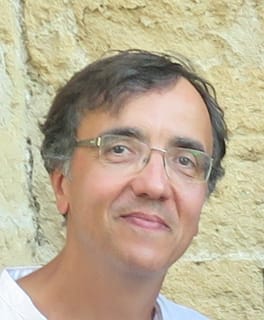
Photo: User:Lycstjeanic + editing: selection of le Sage by User:Boud / CC BY-SA 4.0 (source: Wikimedia Commons)
Born on September 15, 1964 in Aix-en-Provence, Bouches-du-Rhône, France, Eric Le Sage is a classical pianist, university teacher and music educator. Eric Le Sage is 62 years old as of 2026. Awards on record include prix Caecilia.
My Take
What draws me to Eric Le Sage is how quietly he has built a serious life in music. A French pianist who devoted himself to Schumann and the Romantic chamber repertoire, then doubled as a university teacher passing the craft forward, is not the kind of name that trends, yet that is exactly why I respect him. There is something deeply admirable about an artist who chooses depth over spectacle, refining each phrase rather than chasing fame. I read his prix Caecilia and his teaching not as small footnotes but as proof of a musician committed to the long, patient work of keeping classical music alive.
This take was written by generative AI, one per person, from publicly reported facts (editorial policy). It is a reading of the record, not reporting.
1. Profile
- Name (English)
- Eric Le Sage
- Name (Japanese)
- エリック・ル・サージュ
- Reading
- えりっく・る・さーじゅ
- Born
- September 15, 1964 (age 62)
- Origin
- Aix-en-Provence, Bouches-du-Rhône, France
- Occupation
- classical pianist / university teacher / music educator / pianist / musician
- Zodiac / Chinese zodiac
- Virgo / Dragon
2. Background
Awards & achievements
- prix Caecilia
3. Links
4. About this entry
Tags
- Last updated
Facts are limited to publicly available information up to 2024; non-public or unconfirmed items are omitted. English text is machine-assisted (facts translated by Sonnet, "My Take" written by Opus 4.8). The Japanese page is the source of record.
Frequently asked questions
When was Eric Le Sage born?
Born September 15, 1964 (age 62).
Where is Eric Le Sage from?
Eric Le Sage is from Aix-en-Provence, Bouches-du-Rhône, France.
What does Eric Le Sage do?
Eric Le Sage works as classical pianist, university teacher, music educator, pianist, musician.
Classical pianist — see all → · University teacher — see all → · More people from France →