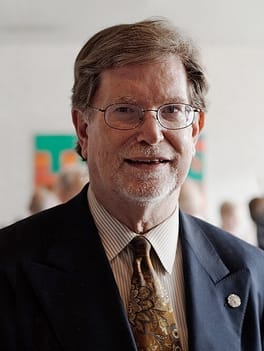
Photo: Nomo michael hoefner http://www.zwo5.de / CC BY 3.0 (source: Wikimedia Commons)
Public records list George F. Smoot as an astronomer, cosmologist and astrophysicist. George F. Smoot was born in Yukon, Florida, United States on February 20, 1945. Education on record includes Upper Arlington High School. Recorded honors include Nobel Prize in Physics (2006), NASA Exceptional Scientific Achievement Medal (1992), Oersted Medal (2009) and 4 more.
My Take
George Smoot belongs to a rare class of people who answered cosmic questions with hard data. Sharing the 2006 Nobel Prize for mapping the anisotropy of the cosmic microwave background, he essentially measured the faint afterglow of the Big Bang and gave the theory its evidence. What fascinates me is the patience that work demands: years of instrumentation just to read whispers from the dawn of time. The Einstein Medal and Lawrence Award only underline the breadth of his impact. I find him genuinely inspiring, a Floridian who turned the entire universe into a laboratory and never lost his curiosity along the way.
This take was written by generative AI, one per person, from publicly reported facts (editorial policy). It is a reading of the record, not reporting.
1. Profile
- Name (English)
- George F. Smoot
- Name (Japanese)
- ジョージ・スムート
- Reading
- じょーじ・すむーと
- Born
- February 20, 1945
- Origin
- Yukon, Florida, United States
- Occupation
- astronomer / cosmologist / astrophysicist / physicist / university teacher
- Zodiac / Chinese zodiac
- Pisces / Rooster
2. Background
- High school
- Upper Arlington High School
Awards & achievements
- 2006 Nobel Prize in Physics
- 1992 NASA Exceptional Scientific Achievement Medal
- 2009 Oersted Medal
- Fellow of the American Physical Society
- 2003 Albert Einstein Medal
- 1994 Ernest Orlando Lawrence Award
- 2007 honorary doctorate of the University of the Mediterranean - Aix Marseille II
3. Links
4. About this entry
Tags
- Last updated
Facts are limited to publicly available information up to 2024; non-public or unconfirmed items are omitted. English text is machine-assisted (facts translated by Sonnet, "My Take" written by Opus 4.8). The Japanese page is the source of record.
Frequently asked questions
When was George F. Smoot born?
Born February 20, 1945.
Where was George F. Smoot from?
George F. Smoot was from Yukon, Florida, United States.
What did George F. Smoot do?
George F. Smoot worked as astronomer, cosmologist, astrophysicist, physicist, university teacher.
Astronomer — see all → · More people from the United States →